
By BY ISABELLA KWAI AND MIKE IVES from NYT Briefing https://ift.tt/2UQgpto
via IFTTT
(MIAMI) — Passengers from an ill-fated South American cruise are eager to disembark once they reach Florida, but Gov. Ron DeSantis said the state’s health care resources are already stretched too thin to take on the ships’ coronavirus caseload. The U.S. Coast Guard said Tuesday that the decision would be punted to Washington if authorities can’t agree.
With the Zaandam and Rotterdam ships set to arrive later this week and at least two people on board needing emergency attention, a “unified command” of state, local and federal officials will be asked to approve a detailed docking plan requiring the cruise line, Holland America, to handle all medical issues without impacting South Florida’s already-stressed hospitals.
“There are no great choices left. These are all tough outcomes,” Coast Guard Captain Jo-Ann Burdian told Broward County commissioners at an emergency meeting Tuesday.
Two of the four deaths on board the Zaandam have been blamed on COVID-19 and nine people have tested positive for the novel coronavirus, the company said.

Holland America said the Rotterdam took on nearly 1,400 people who appear to be healthy from its sister ship, leaving 450 guests and 602 crew members on the Zaandam, including more than 190 who said they are sick. More than 300 U.S. citizens are on both ships combined.
The governor said Tuesday he had been in contact with the White House about getting medical supplies to the ships.
“Just to drop people off at the place where we’re having the highest number of cases right now just doesn’t make a whole lot of sense,” DeSantis said at a news conference.
President Donald Trump said Tuesday that he would speak to DeSantis about the ships.
“They’re dying on the ship,” Trump said. “I’m going to do what’s right. Not only for us, but for humanity.”
Holland America President Orlando Ashford penned an opinion column in the South Florida Sun Sentinel to plead with officials and residents to let the passengers disembark.
Broward County Sheriff Gregory Tony called the situation a “humanitarian crisis” and asked commissioners at the Tuesday meeting not to decide based on emotion. Allowing the ship to dock would burden the local health care system and put residents at risk of additional exposure, he warned.
“This ship has been turned away from several countries already,” Tony said. “We are in some very, very critical circumstances where we as a county are going to have to determine are we willing to take on this responsibility.”
William Burke, chief maritime officer for Carnival, which owns Holland America, told commissioners “we are coming to the place of last resort,” and that his staff had worked through the night on a docking plan. Four people on board have already died. Burke said he hopes two others who are severely ill “will survive the transit.”
Many of the commissioners were sympathetic about the passengers’ plight, including Broward County Commissioner Nan Rich, who urged officials to quickly hammer out a plan.
“These people have been turned away from so many countries, one after the other. We are their last hope. What are we going to do? Let this ship go back out to sea and float around and let people die? I don’t think so,” Rich said.
The meeting ended Tuesday without a decision as Holland America continues to work out the details to dock the ship taking all the precautions advised by the CDC and other agencies.
Carnival said in a Securities and Exchange Commission filing Tuesday that it has about 6,000 passengers on ships that are still at sea, and the company expects to have them disembarked by the end of April.
Carnival spokesman Roger Frizzell said Tuesday night that the company had 40 ships at sea when it halted new cruises in mid-March.
“We expect to have three ships at sea by the end of this week,” Frizzell said.
The Zaandam and other ships became pariahs as countries sealed borders in response to the pandemic. Zaandam passengers said they were asked to keep their rooms dark and leave their drapes closed as they passed through the Panama Canal.
While many have reported feeling ill, most of the passengers and crew on both ships appear to be in good health.
Laura Gabaroni and her husband Juan Huergo, who work for a defense contractor in Orlando, saw their dream vacation turn harrowing as countries shunned them and people fell ill. Fever-free and without symptoms, she and her husband were transferred to the Rotterdam. She wrote DeSantis imploring her governor to let them off.
“Florida continues to receive flights from New York, and it allowed spring break gatherings to go on as planned. Why turn their backs on us?” Gabaroni said.
The Zaandam originally departed from Buenos Aires on March 7 — a day before the U.S. State Department advised to avoid cruise travel and before any substantial restrictions were in place in Florida.
The ship had been scheduled to stop in San Antonio, Chile, and then depart on another 20-day cruise to arrive in Fort Lauderdale in April. But beginning March 15, the Zaandam was denied entry port after port.
Passenger Emily Spindler Brazell, of Tappahannock, Virginia, said they’ve been treated to unlimited phone calls, wine and nice meals including lamb chops and salmon. But they have had to isolate in their rooms.
“The captain said something like, ‘This is not a trip anymore. This is not a cruise. This is a humanitarian mission,’” she said.

(WASHINGTON) — The captain of a U.S. Navy aircraft carrier facing a growing outbreak of the coronavirus is asking for permission to isolate the bulk of his roughly 5,000 crew members on shore, which would take the warship out of duty in an effort to save lives.
In a memo to Navy leaders, the captain of the USS Theodore Roosevelt said that the spread of the disease is ongoing and accelerating and that removing all but 10% of the crew is a “necessary risk” in order to stop the spread of the virus. The ship is docked in Guam.
Navy leaders on Tuesday were scrambling to determine how to best respond to the extraordinary request as dozens of crew members tested positive.
“We are not at war. Sailors do not need to die. If we do not act now, we are failing to properly take care of our most trusted asset our sailors,” said Navy Capt. Brett Crozier in a memo obtained by The Associated Press.
A Navy official said Crozier alerted commanders on Sunday evening of the continuing challenges in isolating the virus. The official, who spoke on condition of anonymity to discuss internal deliberations, said that Crozier wants more isolated housing for the crew and that Navy leadership is reviewing options to ensure the health and safety of the crew.
U.S. Pacific Fleet commander Adm. John Aquilino told reporters on Tuesday that the Navy is working to get as many sailors as possible on shore, while still maintaining a core crew to monitor the nuclear reactors and keep the ship running. He said the pace may not be as fast as the commander would like, but it will be done on a rotation, with sailors staying on shore in isolation for 14 days, then returning to the ship virus-free so that others can go ashore.
Asked about efforts to isolate sailors on shore, he said the Navy is doing what it can with facilities that are available. Officials are working with the government of Guam to try to get hotel rooms that will allow for greater isolation, Aquilino said.
Aquilino would not discuss exact numbers or timelines, but agreed with Navy Secretary Thomas Modly’s assertion that about 1,000 sailors have been taken off the ship so far. He added that no sailors are currently hospitalized.
For most people, the new coronavirus causes mild or moderate symptoms, such as fever and cough, that clear up in two to three weeks. For some, especially older adults and people with existing health problems, it can cause more severe illness, including pneumonia, and death.
In Asia, a carrier presence is central to what the Pentagon has identified as a fundamental shift from fighting insurgent and extremist conflicts in the Middle East to a return to “great power competition.” That means, principally, a bigger focus on China, including its militarization of disputed areas of the South China Sea.
The outbreak on the carrier may be the Navy’s most dramatic, but it tracks an accelerating upward trend across the military. The Pentagon said the number of cases in the military reached 673 on Tuesday morning, a jump of 104 from the day before and up from 174 a week ago.
Since March 20, the total has surged tenfold, even as the Pentagon has taken many steps to try to limit the spread, including halting nearly all movement of troops overseas.
The carrier, like other Navy ships, is vulnerable to infectious disease spread given its close quarters. The massive ship is more than 1,000 feet long (305 meters long); sailors are spread out across a labyrinth of decks linked by steep ladder-like stairs and narrow corridors. Enlisted sailors and officers have separate living quarters, but they routinely grab their food from crowded buffet lines and eat at tables joined end-to-end.
Listing many of those problems, Crozier’s memo, which was first reported by the San Francisco Chronicle, warns that the close quarters means that thousands of sailors now require quarantine. He said sailors have been moving off the ship into shore-based quarters, but much of that is also not adequate. He said much of the off-ship locations available so far are group quarantine sites, and already two sailors housed in an auditorium have tested positive for the virus.
To stop the spread of the virus and prevent death, Crozier said they must take a methodical approach, move the majority of the sailors off the ship, isolate them and completely clean it. He said about 10% of the crew would have to stay on board to secure the vessel, run critical systems and sanitize everything. Aquilino declined to confirm that estimate but said he is working with commanders to get people quarantined and tested as quickly as possible.
While removing that many may seem like an extraordinary measure, Crozier said it is a necessary risk.
“It will enable the carrier and air wing to get back underway as quickly as possible while ensuring the health and safety of our sailors,” Crozier said, adding that finding appropriate isolation for the crew “will require a political solution, but it is the right thing to do.”
Modly told CNN that efforts are underway to help the ship while ensuring that the Navy and the U.S. military continue to protect the country.
“This is a unique circumstance,” he said. “And we’re working through it and trying to maintain that proper balance to ensure that our friends and allies, and most importantly our foes and adversaries out there, understand that we are not standing down the watch.”
___
AP National Security writer Robert Burns contributed to this report.

(BOISE, Idaho) — A large earthquake struck north of Boise, Idaho, Tuesday evening, with people across a large area reporting shaking.
The U.S. Geological Survey reports the magnitude 6.5 temblor struck just before 5 p.m. It was centered 73 miles (118 kilometers) northeast of Meridian, Idaho, near the rural mountain town of Stanley.
Marcus Smith, an emergency room health unit coordinator at St. Luke’s Wood River Medical Center, said the hospital, about 65 miles (104 kilometers) south of the epicenter, shook but the quake didn’t interfere with the treatment of any patients. The hospital in Blaine County is on the front line of Idaho’s coronavirus outbreak, in a region with the highest per-capita rates of known COVID-19 cases in the nation outside of New York City and surrounding counties.
“It felt like a wave going through the ground, so I knew right away what it was. It just felt like waves going through the ground,” he said.
The earthquake is added stress during an already stressful time for the region, but Smith said everything seemed fine, for now. “Until the next one, I guess,” Smith said. “I mean, that’s what we do. We’re all good.”
Brett Woolley, a restaurant owner in Stanley, said he heard earthquake coming before he felt it.
“I heard the roar, and at first it sounded like the wind but then the roar was tremendous,” Woolley said about 10 minutes after the earthquake. “The whole house was rattling, and I started to panic. I’m sitting here perfectly still and the water next to me is still vibrating.”

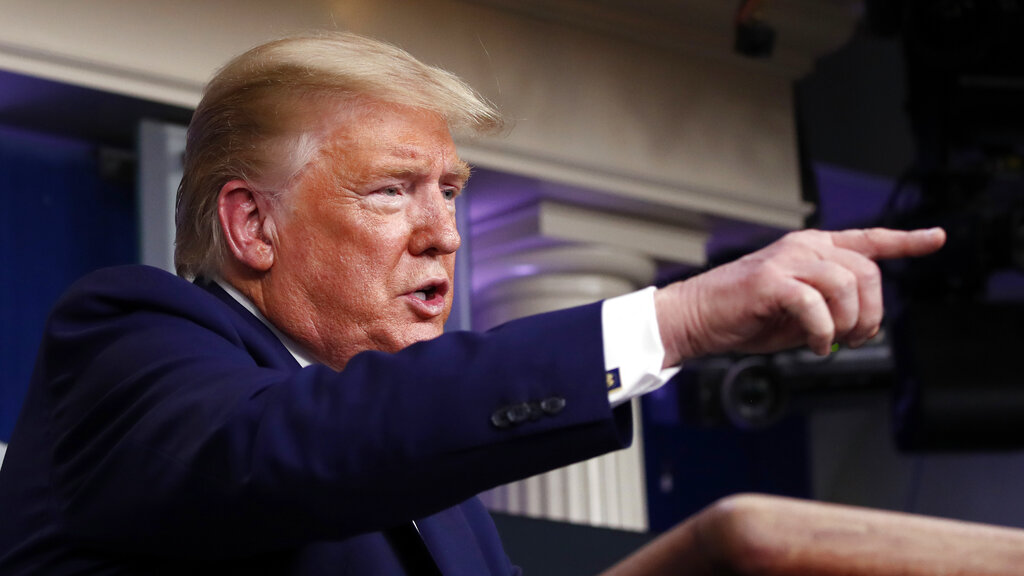

On Friday, Mar. 27, President Donald Trump took what appeared to be bold, decisive action in the fight against the new coronavirus. Reaching for wartime powers under the Defense Production Act, Trump ordered the federal government to “use any and all authority” to force auto giant General Motors to produce ventilators, the life-saving medical devices desperately needed by patients and hospitals struggling to survive the fast-spreading COVID-19 respiratory illness. For good measure, Trump tweeted, “General Motors MUST immediately open their stupidly abandoned Lordstown plant in Ohio, or some other plant, and START MAKING VENTILATORS, NOW!!!!!!”
But if Trump’s Friday performance conveyed urgency and action, four days later, neither is anywhere in evidence. Despite the tough talk and the invocation of presidential powers, Trump and his team by midday on Tuesday had yet to formally file a single order for a GM-made ventilator. While negotiations were ongoing, they had set no mandatory timeline for delivery of the machines, or even suggested a voluntary one. And they had not informed GM of what prices the federal government will pay for the machines under Trump’s executive order. For its part, GM has continued following the plan to produce ventilators that it had discussed with the White House for weeks prior to Trump’s order, a plan that was already well underway when he issued it, according to documents reviewed by TIME.
The GM episode is just the latest in what has become a common Trump-led scene during the pandemic’s spread. As known U.S. cases skyrocketed from 98 to 177,300 over the last four weeks, Trump has made vocal public shows of action that in several cases have yielded few real results. On Mar. 13, he declared Google was building a website to help people find local coronavirus testing sites. Thus far, it has ended up being little more than a bare-bones, aggregational site with a series of links. That same day, he promised big box retailers—Walgreens, Walmart and CVS—would roll out drive-thru testing sites in their parking lots, a notion that also hasn’t fully materialized.
Sign up for our daily coronavirus newsletter by clicking on this link, and please send any tips, leads, and stories to virus@time.com.
It’s not unusual for a president to use his position to project optimism and progress at times of crisis. FDR famously declared in 1932, during the depths of the Great Depression, that America demanded “bold, persistent experimentation” and that if a first effort failed to “admit it frankly and try another.” Trump aides claim that his efforts are spurring action and setting a positive tone at the top. But Republican and Democratic critics say Trump’s approach appears to be less focused on solving the life and death problems that COVID-19 are imposing on Americans, than on the political challenges the disease is presenting to him.
The GM case in particular brought together several political vulnerabilities for Trump. First, it was taking place in Michigan, a state he barely won in 2016, where Republicans fared poorly in the 2018 mid-terms and where Trump is currently trailing Joe Biden by 3 or more percentage points in several polls. More broadly, Trump’s order came as he was under repeated criticism for not taking more action to help states in desperate need of assistance. “They were getting a lot of pressure,” says Michigan Democratic Rep. Elissa Slotkin, a former Defense Department and CIA official who sponsored bipartisan legislation to require the president to implement the DPA to speed the production and distribution of supplies.
As Trump continues to project action and accomplishment, COVID-19 cases continue to spike and so does the urgency of demand from mayors, governors and leaders around the world for ventilators. The coronavirus pandemic has killed more than 41,650 people across the globe, including more than 3,500 Americans. The sickest of those infected have severe inflammation in their lungs, which stiffens them, and makes it impossible to breathe without help from a ventilator. Some of these victims need the device for weeks at a time. Hospital staff say they are concerned about shortages of specialized equipment. If the system swells over capacity, doctors and nurses worry they may ultimately have to ration health care and decide who lives and who dies. Trump’s medical advisors said Monday that even if everything goes perfectly the number of deaths in America could hit 240,000.
Some at GM say it is unfair for the President to make them the bad guys. “It felt like we were getting punched in the gut,” says a long-time GM employee, who wasn’t authorized to speak publicly on the matter. “We did everything in our power to transition from building Tahoes to building ventilators without any guarantee of a federal contract.”
In any case, the company’s officials say, they’re not waiting for direction from the federal government or anyone else. GM forged a deal with Seattle-area ventilator manufacturer Ventec Life Systems and already has begun retooling a factory to build thousands of them beginning next month. “We’re not waiting around for anyone to dictate what number of ventilators need to be made,” says Chris Brooks, Ventec’s chief strategy officer. “Our north star has always been to make as many ventilators as possible, as quickly as possible, to arm front-line medical professionals with the tools they need to save lives.”
GM’s strategy to build ventilators began as the company was facing its own coronavirus crisis. Like other companies around the country, it was projecting dramatic contraction in demand for its cars as unemployment spiked and spending plummeted nationwide. At the same time, it needed to temporarily close plants to prevent the spread of the virus. On March 17, ten days before Trump’s big announcement, and the day before GM announced it would shutter all of its North American factories due to coronavirus, GM CEO Mary Barra called White House economic adviser Larry Kudlow to discuss converting factory space for ventilator production.
Kudlow and the White House turned to a newly formed organization of business leaders, called StopTheSpread.org, for help. The group is led by the former American Express CEO Kenneth Chenault and Rachel Carlson, founder of the online education firm Guild Education, who volunteered to help the Trump Administration in harnessing private industry. In exploratory phone calls with GM, the group discovered what the automaker needed was a medical device-making partner with a reputable product.
StopTheSpread.org matched them up with Ventec, maker of a toaster-sized device known by its acronym, VOCSN (for ventilator, oxygen, cough, suction and nebulizer). On Mar. 18, the two companies held initial phone calls to discuss what could be done. The next day, GM chartered a late-night flight and four engineers, including Phil Kienle, manufacturing chief for North America, flew from Detroit to Seattle for face-to-face talks.
The GM team spent the next three days at Ventec’s headquarters in Bothell, Wash. examining machines that breathe life into immobilized people who can’t do it on their own. They pored over blueprints illustrating where each of the device’s 700 parts come together largely by hand. Images of the parts were handed to a GM purchasing agent see if suppliers could replicate the handiwork. “We sourced literally hundreds of parts and components in just over a week, which is lighting speed, and we will begin production by mid-April,” says Gerald Johnson, GM executive vice president of global manufacturing. “From there, production will scale up to 10,000 or more per month very quickly.”
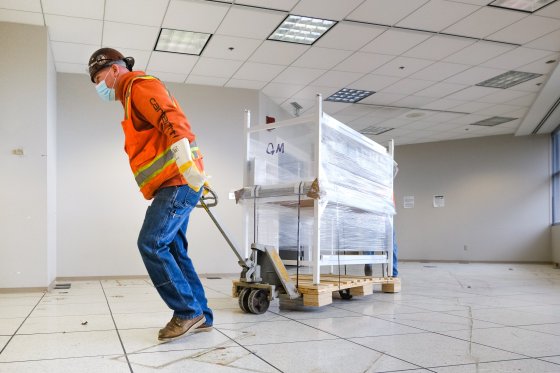
Next up were workers. GM called 1,000 workers to see if they were willing to come to work for the company on ventilators. Greg Wohlford, chairman of United Auto Workers Local 292, which represents the shuttered GM plant in Kokomo, Ind., told the Kokomo Tribune he was just waiting to hear about the training details. “It’s going to happen, we’re just trying to work out all the details,” he said. “But everybody is thrilled. Everyone is really excited.” New manufacturing space was located in a 2.6 million square foot facility with clean rooms where small electronic components for cars are manufactured. Construction workers began tearing up carpet and knocking down walls to make way for additional workstations. Cameras were installed to document the progress.
All told, it took less than a week for GM to forge a partnership with Ventec, according to internal communications, travel logs and interviews with both companies’ officials. The companies produced a full set of manufacturing plans that leveraged union labor, industrial buying power and a worldwide chain of 700 suppliers. Ultimately, the companies claimed they would be able to produce up to 21,000 ventilators a month, if needed.
On Mar. 23, GM and Ventec presented the Federal Emergency Management Agency with the strategy. The companies provided the administration with an itemized list that laid out how many ventilators could be produced, how quickly and at what cost, depending on the options the federal government selected, according to two officials involved in the contracting process.
And then they waited to hear back.
Four days later, they got their response. First, at 11:16 a.m. on March 27, Trump issued a series of tweets blasting GM and Barra. Then, later, at the White House, he elaborated. “We don’t want prices to be double, triple what they should be,” he told reporters. “So General Motors, we’ll see what happens, but now they’re talking. But they weren’t talking the right way at the beginning, and that was not right to the country.” GM pushed back in a public statement that said the company’s commitment to the Ventec ventilator project “has never wavered” and that “GM is contributing its resources at cost.” Officials insisted nothing had changed in their schedule.
In the days leading up to Trump’s comments, governors and lawmakers from the hardest-hit states pleaded with him to use the DPA, a little-known Cold War-era law that enables the president to force businesses to accept and prioritize government contracts during natural disasters, terrorist attacks and other emergencies. Dwindling supplies of respirator masks, gowns, gloves and other basic protective equipment are pushing the nation’s front-line medical workers toward a breaking point.
Politicians from both parties were convinced that using the statute could prevent counterproductive bidding wars that were breaking out across the country, as states competed with each other to acquire the same medical supplies from suppliers. New York Governor Andrew Cuomo said ventilators on the market now cost more than $50,000, which represents a 150% increase from the $20,000 when his state first tried to purchase them.
Trump has insisted that invoking the DPA was government overreach and that companies were stepping up on their own. But perceptions of a weak federal response to the growing crisis is seen as a political liability to Trump in key election states, including Ohio and Michigan. When on Mar. 26, for example, Michigan Governor Gretchen Whitmer, a Democrat, publicly said her state wasn’t getting the medical equipment it needed, Trump responded on Twitter that she was “way in over her head” and that she “doesn’t have a clue.”
The administration says Trump’s Mar. 27 flare-up had nothing to do with politics. By invoking the DPA, the president compelled GM to “to accept, perform, and prioritize contracts or orders for the number of ventilators,” according the executive order. Peter Navarro, Trump’s Trade Adviser and Policy Coordinator for the DPA, told TIME in a statement that the GM action aimed to jumpstart work on ventilators. “Prior to the DPA order being signed, the GM/Ventec venture was sputtering. Since the DPA order was signed, GM has moved into high gear. That’s the poster child of an effective DPA action,” Navarro said.
Navarro also says the President’s declaration was designed to spur competition between different automakers turning to produce ventilators. Ford is working with GE Healthcare to increase GE’s production of its own advanced ventilators, although manufacturing details remain unclear. Ford announced Monday it plans to make as many as 50,000 smaller ventilators, which are licensed by GE, within 100 days at a plant in Ypsilanti, Mich. Now that GM has been pushed publicly by Trump, Navarro suggests, there will be urgency to sprint to the market first. “Now let’s see which venture rolls the first hundred ventilators off their new assembly lines—Ford/GE or GM/Ventec. We expect that within the next 30 days, American lives are at stake, and GM’s lesson from this should be you can’t get to the finish line until you first get to the starting line. Now, a very real race is on.”
Whatever the logic behind Trump’s public statements about GM and his use of emergency powers, the company maintains that Trump’s tough talk resulted in no change from the Mar. 23 plan they presented to his government. Two days after his Mar. 27 statements, on Sunday, Trump was asked at the White House how negotiations GM were going since he invoked DPA two days earlier. Although nothing had changed, he responded that the automaker was now doing a “fantastic job.”

The site of the U.S. Open tennis tournament in New York is going to be used for 350 temporary hospital beds and to prepare food packages during the coronavirus pandemic.
U.S. Tennis Association spokesman Chris Widmaier says an area that houses indoor courts at the Billie Jean King National Tennis Center in Flushing Meadows will begin to be converted into a medical facility starting Tuesday.
New York state and city officials are trying to increase hospital capacity by up to 87,000 beds to handle the outbreak.
Widmaier adds that kitchens at Louis Armstrong Stadium — the second-largest arena used for the Grand Slam tournament scheduled to begin in late August — will be used for putting together 25,000 meal packages per day for patients, workers, volunteers and schoolchildren in the city.
The USTA originally had said it was going to keep the facility open for people to take lessons, practice or play tennis.
But then the group changed course and said it was shutting the site to the public.
The Wall Street Journal first reported on the use of the tennis center.

(WASHINGTON) — The FBI has reached out to Sen. Richard Burr about his sale of stocks before the coronavirus caused markets to plummet, a person familiar with the matter said Monday.
The outreach suggests federal law enforcement officials may be looking to determine whether the North Carolina Republican exploited advance information when he dumped as much as $1.7 million in stocks in the days before the coronavirus wreaked havoc on the economy.
Burr has denied wrongdoing but has also requested an ethics review of the stock sales.
The Justice Department’s action, first reported by CNN, was confirmed by a person familiar with the matter who was not authorized to discuss it and spoke on condition of anonymity. The Justice Department declined to comment.
In a statement, Alice Fisher, an attorney for Burr, said, “The law is clear that any American -– including a Senator -– may participate in the stock market based on public information, as Senator Burr did.
“When this issue arose, Senator Burr immediately asked the Senate Ethics Committee to conduct a complete review, and he will cooperate with that review as well as any other appropriate inquiry. Senator Burr welcomes a thorough review of the facts in this matter, which will establish that his actions were appropriate,” the statement said.
Burr, whose stock sales were first reported by ProPublica and The Center for Responsive Politics, is one of several senators whose financial dealings have generated scrutiny in recent weeks.
Senate records show that Burr and his wife sold between roughly $600,000 and $1.7 million in more than 30 transactions in late January and mid-February, just before the market began to nosedive and government health officials began to sound alarms about the virus. Several of the stocks were in companies that own hotels.
Burr has acknowledged selling the stocks because of the coronavirus but said he relied “solely on public news reports,” specifically CNBC’s daily health and science reporting out of Asia, to make the financial decisions.
There is no indication that Burr, whose six-year term ends in 2023 and who does not plan to run for reelection, was acting on inside information. The intelligence panel he leads did not have any briefings on the pandemic the week when most of the stocks were sold, according to a person familiar with the matter who spoke on condition of anonymity to discuss confidential committee activity.
___
Associated Press writers Mary Clare Jalonick and Michael Balsamo in Washington contributed to this report.

(TOKYO) — Before the Olympics were postponed, Japan looked like it had coronavirus infections contained, even as they spread in neighboring countries. Now that the games have been pushed to next year, Tokyo’s cases are spiking, and the city’s governor is requesting that people stay home, even hinting at a possible lockdown.
The sudden rise in the number of virus cases in Tokyo and the government’s strong actions immediately after the Olympic postponement have raised questions in parliament and among citizens about whether Japan understated the extent of the outbreak and delayed enforcement of social distancing measures while clinging to hopes that the games would start on July 24 as scheduled.
With the Olympics now off, many are voicing suspicion that the numbers are rising because Japan suddenly has no reason to hide them.
“In order to make an impression that the city was taking control of the coronavirus, Tokyo avoided making strict requests and made the number of patients look smaller,” former Japanese Prime Minister Yukio Hatoyama said in a tweet. “The coronavirus has spread while they waited. (For Tokyo Gov. Yuriko Koike) it was Olympics first, not Tokyo’s residents.”
Experts have found a rise of untraceable cases mushrooming in Tokyo, Osaka and other urban areas — signs of an explosive increase in infections.
Prime Minister Shinzo Abe said Saturday that Japan is now on the brink of a huge jump in cases as it becomes increasingly difficult to trace and keep clusters under control.
“Once infections overshoot, our strategy … will instantly fall apart,” Abe warned. “Under the current situation, we are just barely holding up.” He said a state of emergency is not needed just yet, but that Japan could at any time face a situation as bad as in the United States or Europe.
There was less of a sense of urgency displayed recently when many people visited parks for cherry blossom viewing, and Abe was only hinting at an Olympic postponement. But in a phone call with International Olympic Committee President Thomas Bach last Tuesday, Abe agreed to postpone the games until around the summer of 2021 because of the coronavirus pandemic.
A day later, Koike asked Tokyo residents to stay home weekends until mid-April, saying confirmed cases of the coronavirus had shot up to 41 in a day from 16 earlier in the week. On Saturday, Tokyo reported 63 new cases, another single-day record. Koike said that infections in Tokyo were on the brink of an explosive increase, and that stronger measures, including a lockdown, could be needed if the spread of the virus doesn’t slow.
”Is this just a coincidence?” Maiko Tajima, an opposition lawmaker from the Constitutional Democratic Party of Japan, said during a parliamentary session last Wednesday, citing Tokyo’s sudden spike.
Health Minister Katsunobu Kato said there is “absolutely no relationship” between the Olympic postponement and the number of confirmed cases. Abe cited experts as saying a big reason for the recent rise is the growing number of cases that can’t be linked and a jump in infections from abroad. The prime minister told people to “be prepared for a long battle.”
A day after Koike’s warning, Abe convened a new task force under a recently enacted special law that would allow him to declare a state of emergency in specific areas, including Tokyo.
Japan’s strategy has been to focus on clusters and trace infection routes rather than testing everyone. A guideline issued Saturday still says that tests will be conducted per clinical doctors’ advice. Experts set a high bar for testing eligibility, allowing them only for those linked to clusters or those with symptoms, because they fear massive testing will fill up beds that are needed for patients in severe need, and cause a collapse of medical systems.
From Feb. 18 to March 27, Japan tested about 50,000 people, a daily average of 1,270 — fewer than the national daily capacity of several thousand. There was only a slight increase in the number of tests in the past week. In Tokyo, fewer than 2% of those who sought advice on a government hotline had been tested, according to health ministry figures. South Korea, by contrast, had tested about 250,000 people by mid-March.
Abe denied allegations that Japan had manipulated the numbers by limiting tests, or combined COVID-19 deaths with other pneumonia fatalities. “I’m aware that some people suspect Japan is hiding the numbers, but I believe that’s not true,” he said. “If there is a cover-up, it will show up in the number of deaths.” He said doctors told him that pneumonia patients with COVID-19 can be detected by CAT-scan or X-rays.
Many Japanese experts say testing is not for everyone and should be conducted selectively in an attempt to save hospital beds for those who really need them. “Tests are primarily for people who are suspected of having the virus, and should be based on clinical judgment by doctors,” said Shigeru Omi, a former World Health Organization public health expert who is on the government-commissioned panel.
Aki-Hiro Sato, a professor of information sciences at Yokohama City University, said in a recent report that Japan is now likely facing a second or third wave of the virus coming from Europe and the United States. Tokyo has about 430 cases, but Sato estimated an additional 1,000 might have been infected in Tokyo by late March if infections are accelerating at a pace similar to what’s happening in other countries. Including asymptomatic or light infections, about 10,000 people might be infected, he said.
As of Sunday, Japan had 2,578 confirmed cases, including 712 from a cruise ship, with 64 deaths, according to the health ministry. About 1,000 have recovered.
Under the current law, COVID-19 is designated as an infectious disease and whoever tests positive is routinely hospitalized, but a new government guideline would allow a triage of patients, which would include self-quarantine at home.
Right now, Japan has 2,600 hospital beds designated for infectious disease treatment, including 118 in Tokyo, but about one-third of them are already occupied by COVID-19 patients, according to Satoshi Kutsuna of the Disease Control and Prevention Center. Citing the recent spike, Kutsuna said that an “overshooting of infections is just about to begin, unfortunately.”
Abe has said the government would secure 12,000 beds and 3,000 ventilators to prepare for a worst case scenario.
“We fear a situation where severe patients start dying when the medical system collapses, and we must prevent that situation,” Kato, the health minister, said Sunday on a talk show on public broadcaster NHK.

(NEW YORK) — The family of John Prine says the singer-songwriter is critically ill and has been placed on a ventilator while being treated for COVID-19-type symptoms.
A message posted on Prine’s Twitter page Sunday said the “Angel from Montgomery” singer has been hospitalized since Thursday and his condition worsened on Saturday.
“This is hard news for us to share,” Prine’s family added. “But so many of you have loved and supported John over the years, we wanted to let you know, and give you the chance to send on more of that love and support now. And know that we love you, and that John loves you.”
Prine’s wife and manager Fiona Whelan Prine earlier this month said that she had tested positive for the coronavirus.She said the couple were quarantined and isolated from each other.
The 73-year-old Prine, one of the most influential in folk and country music, has twice fought cancer. Most recently, he was diagnosed with lung cancer in 2013 and had part of a lung removed. The surgeries affected his voice but Prine continued to make music and to tour. Before the onset of the virus, Prine had shows scheduled in May and a summer tour planned.
COVID-19 is the disease caused by the new coronavirus. As of Sunday, it has killed more than 32,000 people worldwide.


