By BY GLENN KENNY from NYT Movies https://ift.tt/3upTAOs
via IFTTT




Jasper Johns, possibly America’s most famous living artist and still plying his trade at 91, launches two retrospectives on Sept. 29; one at the Whitney Museum of American Art in New York City and the other at the Philadelphia Museum of Art. The exhibitions, known collectively as Mind/Mirror, illuminate the through lines of Johns’ large body of work: his fascination with such everyday symbols as numbers, targets, maps and flags; his sometime habit of limiting his color palette to red, blue, yellow and orange; and his exploration of such techniques as collage, hatching and scale. One section of the Whitney is dedicated to his variations on the motif of a Savarin coffee can crammed with brushes, which is widely believed to be the artist’s way of representing himself. Johns, who famously destroyed all his prior work before painting his first flag, lives in Connecticut and rarely gives interviews. He answered questions from TIME via email.
[time-brightcove not-tgx=”true”]
The retrospectives at the Whitney and in Philadelphia are called Mind/Mirror. For you, is art more a way of representing thought, or a way of representing what you see?
I don’t know about more or less. I think it is both and a play between them.
Do you miss anything about being young?
Agility.
What would constitute a perfect day for you?
Few interruptions.
You’ve had friends who were poets and you’ve been interested in the overlap between poetry and art. Do you still read poetry?
I do still read poetry, old and new. I read The Poetry Project’s newsletter when time allows. Friends sometimes email their poems or send copies of recently published books.
One of your friends, the poet Frank O’Hara, wrote that he was “sentimental enough to wish to contribute something to life’s fabric, to the world’s beauty.” Do you feel confident you have done that?
It’s not what I set out to do, but I suppose the possibility that it might be a consequence is a nice thought.
For what in your life do you feel most grateful?
I am lucky for being able to devote myself to work that remains interesting to me.
You have spoken of how many of your works start with “things the mind already knows,” —numbers, colors, targets, flags. Did any of these things start to become unfamiliar?
All familiar things can open into strange worlds.
Would any flag have worked? The Union Jack? The Japanese sun?
My first Flag painting followed a dream of an American flag so that is what I painted.
You have returned in several works to a LIFE photograph by Larry Burrows of a soldier devastated by the death of a fellow soldier. It’s not his most famous image; why did that one speak to you?
I was not familiar with Burrows’ work. The photograph itself seemed to ask for my attention.
A few years later, Burrows died while on assignment in Laos. Is image-making worth dying for?
Dying while on assignment doesn’t seem like a bad idea.
Can any images—as mundane as a coffee can or dramatic as a mourning soldier—still have power in a world so suffused by imagery and information?
Visual information remains a primary source of meaning.
To what do you attribute your long creative life?
One does not plan the length of one’s life, so I might attribute it to chance.
Do you wonder what the last work you make will be?
I sometimes think it is the one I am working on.
Your work is sometimes regarded as chilly or detached. Do you understand that perception?
No.
Robert Rauschenberg said that “Good art can never be understood.” Do you agree?
Not with the language. I don’t know that art can be understood in any final way, but a search for understanding tends to open one’s eyes rather than close them.

As I came of age in Woodville Heights Baptist Church, on the white working-class side of Jackson, Miss., I internalized a cycle of sin, confession and repentance as a daily part of my life. Though I wasn’t aware of it at the time, this was a double inheritance. Beneath this seemingly icy surface of guilt and culpability flowed a deeper current of innocence and entitlement. Individually, I was a sinner, but collectively, I was part of a special tribe. Whatever our humble social stations might be, we white Christians were God’s chosen instruments of spreading salvation and civilization to the world.
[time-brightcove not-tgx=”true”]
The power and sheer cultural dominance of white Christianity in America historically bound these contradictory sensibilities together. But today we are witnessing the unmaking of this white Christian worldview, and it has unleashed remarkably destructive forces into American life.
Understanding this dissolution is the key to deciphering one of the most vexing puzzles in our politics: how a purportedly sober Christian worldview has become a volatile cocktail of fealty to Donald Trump, wild-eyed rants about vaccines, faith in QAnon conspiracies and hysteria over critical race theory.
Read More: White American Christianity Needs to Be Honest About Its History of White Supremacy
Recent surveys by PRRI, an organization I lead, reveal disturbing realities among white evangelical Protestants today: 61% believe the 2020 presidential election was stolen from Donald Trump. And the idea of patriotism has taken a troubling turn: 68% believe Trump is a “true patriot,” and one in three believe that “because things have gotten so far off track, true American patriots may have to resort to violence in order to save our country.” More than seven in ten deny that the history of slavery and discrimination in the U.S. has any bearing on economic inequalities between white and Black Americans today. White evangelicals are the religious group most likely to refuse COVID-19 vaccines and object to mask mandates. One in four are QAnon conspiracy believers.
Understanding how we got here requires entering the white evangelical cultural world, one in which I grew up. As was common, my initiation rites started early. I accepted Jesus as my personal Lord and savior and was baptized at age 6. As I approached adolescence, I was encouraged to cultivate an identity as a disciple of Christ. I was taught to develop my own daily “quiet time,” about 30 minutes dedicated to scripture reading, journaling and prayer.
There were also communal rituals. During informal Sunday evening services, members often “gave their testimony.” Sometimes it was spontaneous, a member rising to break the prayerful silence. But the practice was also built into the liturgy (although we would never have used that suspect word, which belonged more to the Episcopalians on the other side of town). These scheduled talks were marked “Testimony” in the bifold church bulletin, with the name of the recruited witness indicated on the right margin.
Critically, what stitched these private and public practices together was an emphasis on personal sin. Common themes were failures in roles and priorities. The grown-ups promised to be more honest in their business dealings and to be more godly parents and spouses—husbands better leaders and wives more pliant to that leadership. When youth were invited to testify, we were often given guidance about how to be honest but appropriate—typically an expression of regret coupled with a promise to reform from running with the wrong crowd.
Read More: The Growing Anti-Democratic Threat of Christian Nationalism in the U.S.
But like a torch held too near the eyes in a dark room, these acts of intense discipleship illuminated little beyond our insular community. Nothing outside our intimate lives, not even (or particularly) major racial upheavals in our community, were perceptible objects of Christian concern.
When Black kids finally showed up in my third-grade classroom in the 1975-76 school year—a full two decades after Brown v. Board of Education—my white Sunday school teachers and pastor remained silent about this transformation of our daily social lives. When Ronald Reagan launched his 1980 presidential campaign with a speech emphasizing “states’ rights” in Neshoba County, where three civil rights workers had been murdered during Freedom Summer, Mississippi’s white Christians responded by consummating their marriage to the Republican Party, one that remains strong today. When Byron De La Beckwith was finally convicted in 1994 for the 1963 murder of civil rights leader Medgar Evers, there were no discussions in my Southern Baptist seminary about the silence and complicity of white Christian churches during those murderous days or since—even though De La Beckwith had been a member in good standing at a white Christian church and Evers’s last act had been organizing an unsuccessful campaign to integrate Jackson’s influential First Baptist Church.
Looking back on it now, it’s clear that this intense preoccupation with personal sin, by design, kept our field of vision shallow and allowed us to sit, Sunday after Sunday, “silent behind the anesthetizing security of stained-glass windows,” as Martin Luther King Jr. put it so devastatingly in “Letter from Birmingham Jail.”
But now the bulwark of white Christian America is crumbling. We are no longer, demographically speaking, a white Christian nation. White evangelical Protestants—the once self-proclaimed “moral majority”—have fallen from nearly a quarter of Americans just over a decade ago to 14.5% of the public today. And Southern Baptists, who grew to be the largest Protestant denomination of all by the mid-20th century, have lost more than 2 million members across the same period.
As the shadow cast by white Christian churches and institutions is shortening, we’re witnessing in real time the anomie this contraction is producing among many of its adherents. Many are responding by abandoning the ranks. The increasingly desperate remainder are screaming defiantly from the ramparts, determined, to the last man, to defend the breached walls.
James Baldwin wrote, with anger and pity, about the Black experience of seeing white people as “the slightly mad victims of their own brainwashing.” He understood whites, and white Christians in particular, to be trapped in a kind of self-induced psychosis, stemming from the strain of sustaining a conception of themselves as repentant sinners while living lives of indifference and violence toward their fellow Black and brown citizens.
In these twilight years of white Christian America, for those still within the veil, the strain of holding these contradictions can lead to a dissociative state, where self-reflection becomes treasonous and self-delusion a necessity. The fruits of this spirit are abundant. Empathy signals weakness, and disdain strength. Prophets are shunned, and authoritarians embraced. Truth is exchanged for a lie.
Read More: Theologian Russell Moore Has a Message for Christians Who Still Worship Donald Trump
We can puzzle over these phenomena separately, but they are best understood together as symptoms of collective ill health. The willingness of so many white Christians to embrace little lies everywhere stems from the necessity of protecting the big lie that is everything.
W.E.B. Du Bois wrote movingly about the double-consciousness that Black children have thrust upon them in America as their sense of self is distorted and refracted back at them through white eyes. He vividly described the struggle for the Black American “to merge his double self into a better and truer self.”
The problem today for white Americans, particularly we white Christians, is the opposite. Having grown up with the comforting illusion that sinfulness and innocence, humility and dominion can coexist in a single consciousness, it is increasingly evident that this amalgamation is a sign of deep moral, spiritual and political malaise. Rather than holding these warring selves together, we must banish one.
The first step toward recovery is to separate being white from being Christian. Practically, we must reject what have, for too long, been three articles of our faith: that the Bible is a blueprint for a white Christian America; that Jesus, the son of God, is a white savior; and that the church is a sanctuary of white innocence. Most fundamentally, we must confess that whatever the personal sins of white people, in the past and present, they pale in comparison to the systemic ways we have built and blessed a society that reflects a conviction that, to us and to God, our lives matter more.
The only path to health, for both our faith and our democracy, is for white Christians to embrace a terrifying but saving truth: what we have taken to be the bedrock of our faith and a biblical worldview—that we alone are God’s chosen people to bring salvation and civilization to the world—is not an eternal truth grounded in the Bible but rather a self-serving lie rooted in white supremacy.

PARIS — Paris Fashion Week is back after a coronavirus-related hiatus. The high fashion world went mainly digital for a year over the pandemic, but big hitters like Chanel, Hermes and Louis Vuitton are finally returning to the live runway this season. The must-have accessories? The face mask and health pass, bien sur.
Dior made sure that Tuesday’s ready-to-wear comeback — with VIPs such as actress Rosamund Pike and tennis ace Roger Federer — got off to a glitzy start on the first full day of spring-summer 2022 collections. It was the famed house’s first ready-to-wear runway since February 2020 — an emotional return for some.
[time-brightcove not-tgx=”true”]
Here are some highlights, including Saint Laurent:
Designer Maria Grazia Chiuri dived into the Dior archives to return with a playful collection that celebrated color and graphic form.
All around the venue — in an annex inside Paris’ Tuileries Gardens — were colored blocks and retro signs that were a clue to the collection’s 1960s aesthetic.
The show was a homage to former designer Marc Bohan, whose “Slim Look” collection from 1961 defined a generation. (Liz Taylor famously ordered 12 gowns immediately from that iconic show.)

On Tuesday, Chiuri revamped Bohan’s slim styles with her contemporary twist. Bold color-blocking — riffing off the decor — came in a camera-snapping palette of raspberry, red, navy, orange and green.
The display evoked a dream world. Models rotated robotically around the decor to off-kilter music. Stylish boxy ’60s jackets with graphic statement pockets mixed with sporty vests and dresses that channeled a tennis skirt. The main let down of the otherwise tasteful collection were a series of silken boxer pajamas — which made the house appear like it was trying too hard to be youthful.
Read more: Fashion After the Pandemic and the Great Closet Purge
Now that coronavirus travel rules have been relaxed between Europe and the U.S., fashion editors from New York have returned to the City of Light. It was an emotional event for many, who had missed seeing their international friends in the industry.
“It’s nice to see everyone. I’m happy that the system is back. I’m happy that the brands can get this kind of exposure,” said Kenneth Richard, editor-in-chief of The Impression magazine. “It’s a gift what we do.”
Read more: Inside Depop’s Plans for the Future of Fashion Upcycling
Richard expressed skepticism, however, in the way that Paris opened up so fully. Many at the Dior show and others did not wear masks even though seating was extremely cramped. At Milan Fashion Week, social distancing and mask-wearing were more stringently enforced.
“Look at this space, we’re shoulder to shoulder,” Richard said pointing to the four sections of back-to-back seating. “In Milan, everyone was three feet apart.”
Although a third of Paris Fashion Week’s 97 shows this season — including most of the heritage houses — have opted for a physical presence, some two-thirds remain digital.
Former French first lady Carla Bruni and actress Catherine Deneuve looked up to the sky in awe as the Eiffel Tower sparkled at the strike of 8 p.m.
The storied house of Yves Saint Laurent famously said it was renouncing the Paris Fashion Week calendar. But on Tuesday it changed its mind, coming back on the first major day of shows. Thankfully it did — as it might it be crowned the season’s best collection so far.
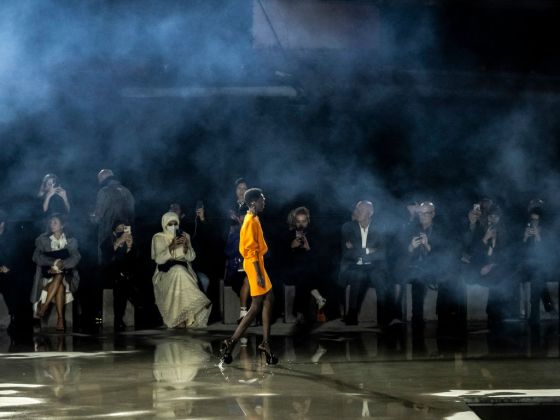
Oozing sex appeal and glamour, designer Anthony Vaccarello was in a confident mood, breaking out of his normally restrictive short-skirted silhouettes for a bold collection that twinned style with provocation.
Notable details included a flash of bright blue gloves on a pale (signature) tuxedo dress. Or a thick gold bracelet contrasting with a color-blocked vermilion suit-skirt. Proportions were at times oversized, with ample silk fabric weighing chicly on dress hems. Exposed nipples on models with piercings mixed this classicism with a fierce street vibe.
Surreal aquatic head gear, masks and breathing apparatus at the Botter show conjured up a underwater dystopia. Or was Rushemy Botter and Lisi Herrebrugh’s show just another swipe at the pandemic?
Either way, the designers were in fine fashion-forward form for spring-summer in their statement about ecology and the state of the oceans.
Read more: The Women Who Took on the Fashion Industry to Save the Birds
A diaphanous curtain billowed as if it were underwater as models strutted out in aquatic themes, including swimming caps, scuba looks, a boxy T-shirt with “CARIBBEAN” on it and a large blue umbrella for a hat. Tongue-in-cheek humor was never far away from the design inspirations and blue, of course, was the defining color of the show.
The house said over half the fabrics in the display were created from recycled ocean plastic.
Kenneth Ize kick-started the week with a vibrant, color-rich display that paid homage to his Nigerian heritage.
There was a lot to prove for the young designer, who was a finalist of the 2019 LVMH Prize and caught global attention for his 2020 debut show because Naomi Campbell hit the runway. Yet he pulled it off with panache.
Moving away from the sober colors of his last collection, Ize used gold shimmer and bright patterns for an optimistic view of spring. Sexy silk slip gowns mixed with fun plays in clashing stripes. Sandals on each of the show’s 29 looks gave off a relaxed vibe.
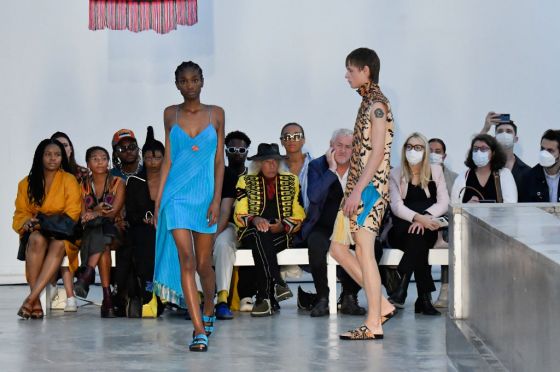
Other garments also evoked couture.
“We produce our woven fabrics using the age-long weaving techniques of the Yoruba people in present day southwestern Nigeria,” Ize told The Associated Press after the show. “We merge these weaving techniques with what we consider our version of modernity, creating a sync between a historical craftsmanship and modern silhouettes.”
Celebrating both continents of Europe and Africa (the designer was born in Vienna to Nigerian parents and grew up in Austria), his couture-conscious craftmanship was evident in gold dresses and diaphanous gold thread, with one fringe billowing down from a bag like in a fairy tale or Greek myth.
Ize is one to watch.


On Sept. 1, Texas enacted an extreme law that effectively ended abortion care in the state. Since then, clinics in states on the western and northern borders have seen a dramatic increase in patient visits and calls from abortion funds. But here in the Gulf region, not much has changed. And that might be the most alarming news of all.
There is no region more crippled by abortion restrictions than the Deep South. Across the more than 800 miles along the Gulf Coast between the eastern edge of Texas and the end of the Florida panhandle, there are fewer than a dozen abortion clinics, and Louisiana, Mississippi and Alabama require a waiting period of 24 or 48 hours between in-person visits to the clinic. That means a traveling patient must either make multiple trips or find the resources for some combination of housing, food, child care and time off work, in addition to paying for the abortion. Most abortion patients come from low-income households, and state laws down here prohibit non-employer-based insurance from covering abortion.
[time-brightcove not-tgx=”true”]
Read More: In Texas, Rape Crisis Centers Struggle to Respond to New Abortion Law
So it is that with Texas prohibiting abortion as early as 14 days after a missed period, clinics in states like New Mexico and Oklahoma are seeing a flood of new appointments, but those in Louisiana, Mississippi and Alabama are not. While our phones at West Alabama Women’s Center ring more than before, it is nowhere near what we would expect with one of the nation’s largest states eliminating nearly all abortion care. It’s not terribly surprising, though. With enough hoops to get through, of course people will be deterred from seeking an abortion in the Deep South. That was the intention.
Those who have the resources are able to travel, some as far as Illinois. But those who don’t? What are they doing now?
It’s a thought that consumes us daily. In Alabama, we’ve long seen patients from Mississippi, where there is just one clinic, and since Hurricane Ida, we’ve seen Louisiana patients unable to get into their own booked clinics. So it’s unlikely that these states are taking in many patients from East Texas.
Read More: I Can’t Do My Job as a Pastor With Abortion Laws Like Texas’ S.B. 8 in Place
Our fear is that pregnant people wanting an abortion have simply stopped trying to access the procedure-—at least for now. Because the ban has continued to have court challenges, including one from the Justice Department, those who are early in their pregnancies may just be waiting, hoping that a new hearing might mean a chance to stay in the state and get a termination. After all, if there will be a judicial review in two weeks and it takes two weeks to book an appointment in Louisiana, does it really make a difference?
Unfortunately, it does. Whether this barrier to health care is temporary or permanent, one thing we know for certain is that people who decide to end their pregnancies will now be doing so later in gestation—either because of waiting for legal abortion to return in Texas or needing to book out-of-state visits weeks in advance. These delays will increase health risks as well as financial burdens and lead more people to take legal risks to terminate. What they will not do, for the large part, is make Texans and others affected in the region decide they should just give birth.
Read More: How Texas’ Abortion Ban Will Lead to More At-Home Abortions
At our clinic, we will continue to do anything we can to meet this need as it arises. We now offer state-mandated informed-consent materials via certified mail, thus starting the clock on the 48-hour waiting period and eliminating one visit, which can be critical for patients traveling hundreds of miles. We will also increase our hours if needed so more patients can access the abortion care they need as quickly as possible, as is their constitutional right.
The problem is this may be just the beginning. With a number of other states considering similar bans—notably Florida—this crisis may get far worse. Florida is currently a destination for those in the region who are unable to navigate their states’ multi-visit requirements. It is also the only state in the region with a number of clinics that is more aligned with the number of people living there. A near total abortion ban would not just cripple that state but every state around it. If Florida’s clinics were unavailable, the domino effect would essentially overflow the Southeast.
Abortion has always existed. Legal or not, it will continue to exist. Texas is playing a dangerous constitutional game—and using pregnant people as collateral.