Showing posts with label top stories. Show all posts

Monday, October 11, 2021

New top story from Time: Timothée Chalamet Wants You to Wear Your Heart on Your Sleeve


Timothée Chalamet and I are on the run, chasing down Sixth Avenue on a bright September day in search of a place to talk. The restaurant in Greenwich Village where we had planned to meet ended up getting swarmed by NYU students while I was waiting for him, chattering excitedly to one another—“Timothée Chalamet is here!” “Shut up!” “Yeah, he’s right outside!”—so, trying to avoid a deluge of selfie seekers, I bolt from the table, tapping Chalamet on the shoulder where he stands under the awning, on the phone, and we make our escape. Face covered with a mask and hoodie pulled up over his curly hair, he’s mostly incognito but still cuts a distinct enough figure that we’d better find a new location fast, and standing at a crosswalk with him, I feel briefly protective, like I should be prepared to body-block an onslaught of fans at any moment.

<strong>“I feel like I’m here to show that to wear your heart on your sleeve is O.K.”</strong>[time-brightcove not-tgx=”true”]

Luckily, we go undetected as we make our way to another diner a few blocks down—a true New York greasy spoon, less crowded and doggedly uncool—and slide into a back booth. He orders black coffee and matzo-ball soup, which he says he has been craving. It’s not an easy thing to come by in London, where he’s been in rehearsals for Wonka, an original movie musical that will serve as a prequel of sorts to Charlie and the Chocolate Factory, following the titular chocolatier as a young man. He just spent a weekend recording music for the film at Abbey Road. “I felt out of my league,” he says of working in that legendary space. “Like I was desecrating history!” But working on this project has been good for him. “It’s not mining the darker emotions in life,” he says. “It’s a celebration of being off-center and of being O.K. with the weirder parts of you that don’t quite fit in.”
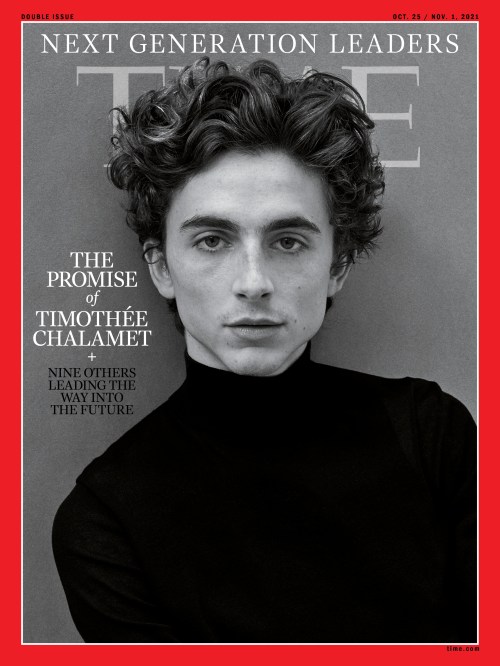
Timothee Chalamet Time Magazine Cover
Photograph by Ruven Afanador for TIME

If Chalamet—whom most people call, affectionately, Timmy—sees himself as off-center, so far it’s working. He’s back in New York for the Met Gala, which he’s co-chairing alongside Billie Eilish, Naomi Osaka and Amanda Gorman. (He walked the red carpet in a Haider Ackermann satin tuxedo jacket and sweatpants.) On Oct. 22, he’ll appear in two films released on the same day. There’s Wes Anderson’s ensemble The French Dispatch, which earned raves out of Cannes, in which Chalamet appears opposite Frances McDormand as a revolutionary spearheading a student liberation movement. He also stars as royal Paul Atreides in Denis Villeneuve’s towering sci-fi epic Dune, an adaptation of Frank Herbert’s beloved 1965 novel, budgeted at a reported $165 million and slated for a massive worldwide release.

This makes it a big moment for Chalamet, who is not just an actor who works often, although he does, and not just a celebrity, although he is one, but a movie star in the old-fashioned sense of the word. (More on this later.) He’s now the rare performer who, at 25, studios are betting can help launch a blockbuster franchise and a festival hit on the same day, with a pandemic still rumbling out of view. With great power, of course, comes great responsibility—including a spotlight on everything from his personal life (he’s been linked to actor Lily-Rose Depp) to his activism (he’s outspoken on climate change) to what he wears, whether on a red carpet or dashing to the bodega. The latter runs the gamut from embroidered joggers to tie-dye overalls to space-age suiting—or, say, a Louis Vuitton hoodie spangled with 3,000 Swarovski crystals. (All this has led GQ to crown him one of the best-dressed men in the world.)

Chalamet belongs to a generation that’s known for oversharing, particularly on social media, but his Instagram is frequently enigmatic; he holds more back than many of his contemporaries. He cites as role models Michael B. Jordan, Leonardo DiCaprio and Jennifer Lawrence—the latter two of whom he’ll appear opposite in Adam McKay’s star-studded Don’t Look Up on Netflix in December—actors who are more likely to talk about craft than to post selfies doing sponsored content. If fame is surreal to him, he also doesn’t make a show of resisting it. “I’m figuring it out,” Chalamet says. “On my worst days, I feel a tension in figuring it out. But on my best days, I feel like I’m growing right on time.”

As we sit and talk, a procession of fans stop by the table to ask for photos—mostly young women, but there’s one sheepish-looking guy, too, who looks to be in his 40s. Chalamet indulges them all gamely, making conversation. “Oh, you go to Columbia?” he says to one girl. “That’s cool! I did too.” He stops himself. “Well, I dropped out.”

If the challenge is staying level amid all this attention, he has a game plan. “One of my heroes—I can’t say who or he’d kick my ass—he put his arm around me the first night we met and gave me some advice,” he says. What was it, I ask?

“No hard drugs,” Chalamet says, “and no superhero movies.”


Chalamet grew up in midtown Manhattan, where his mom was a Broadway performer and his father worked as an editor for UNICEF. He went to the arts high school La Guardia, where he performed onstage. Not long after graduating, he booked a role as Matthew McConaughey’s son in Christopher Nolan’s 2014 space drama Interstellar, which he, along with everyone he knew, expected would catalyze his career. “I remember seeing it and weeping,” he says, “60% because I was so moved by it, and 40% because I’d thought I was in the movie so much more than I am.”

He briefly attended Columbia, then NYU, but didn’t finish college, which he says seems “insane in retrospect.” He remembers the insecurity of those years, which he describes as “the soul-crushing anxiety of feeling like I had a lot to give without any platform.” But he waited for the kinds of jobs he wanted, trying to avoid getting locked into a commitment that might stifle his growth, like a years-long TV contract. “Not that those opportunities were coming at me plenty,” he says, “because they weren’t. But I had a marathon mentality, which is hard when everything is instant gratification.”

That paid off in 2017 with the release of Luca Guadagnino’s gay love story Call Me by Your Name, which earned him an Oscar nomination and catapulted him to fame. (He demurs when asked about co-star Armie Hammer, who has denied a widely publicized accusation of rape. “I totally get why you’re asking that,” he says, “but it’s a question worthy of a larger conversation, and I don’t want to give you a partial response.”) That same year, he featured in Greta Gerwig’s Oscar-nominated Lady Bird. He followed up with the addiction drama Beautiful Boy, then Gerwig’s adaptation of Little Women, both of which earned him still more critical praise.

If his filmography has made him an art-house darling, Dune feels like the perfect big movie for an actor like Chalamet: despite the booming score and dazzling visual effects, there’s a gravity to it—and an unusual prescience. “Dune was written 60 years ago, but its themes hold up today,” Chalamet says. “A warning against the exploitation of the environment, a warning against colonialism, a warning against technology.”

Dune is also the kind of cinematic event that demands to be seen in theaters, which spelled controversy when Warner Bros. announced that, due to the pandemic, all of their 2021 films would premiere on the streaming service HBO Max concurrent with their theatrical release dates. Chalamet shrugs about it. “It’s so above my pay grade,” he says. “Maybe I’m naive, but I trust the powers that be. I’m just grateful it’s coming out at all.”


A day later, we meet at a bar in Tribeca. As he arrives, he’s wrapping up a call. “Love you too, Grandma,” he says gently into the phone as he’s hanging up.

Male movie stars have long been defined by an old model of masculinity. Chalamet, who rose to fame playing a queer character and whose style is frequently described as androgynous, evinces a kind of masculinity that’s a little different: more sensitive, more emotional, in keeping with his generation’s permissive attitudes about self-expression. “Timothée is a thoughtful, poetic spirit,” says Villeneuve. “I am always impressed by his beautiful vulnerability.” Chalamet doesn’t always reveal much, but what he does is intentional. Ask him what he stands for, and he considers it seriously. “I feel like I’m here to show that to wear your heart on your sleeve is O.K.,” he says.

Yet Chalamet knows better than to obsess about how he’s perceived by the public. “To keep the ball rolling creatively takes a certain ignorance to the way you’re consumed,” he says. He calls it a “mirror vacuum”: the black hole you disappear into studying your own reflection. He wants to use his platform thoughtfully, to spread the right kinds of messages through the world—whether that’s about mental-health awareness, a subject which he wants to see become “less of an Instagram slide share and something more intrinsic,” or climate. “I don’t think it’s a coincidence that the same generation that inherits the overheated planet is the generation saying, ‘Hey, there’s a level of complacency here,’” he says.

All that said, Chalamet doesn’t take himself too seriously. The idea that he’s seen as a movie star—let alone his generation’s most promising—seems to make him squirrelly. “I don’t want to say some vapid, self-effacing thing,” he says. “It’s a combination of luck and getting good advice early in my career not to pigeonhole myself.” The term movie star, to him, is “like death.” All it does is make him think about ’90s-nostalgia Instagram feeds.

“You’re just an actor,” Chalamet says, like a mantra. “You’re just an actor!” Then he looks to me, as if checking to see if he’s convinced me it’s true.

Cover styled by Erin Walsh; grooming by Jamie Taylor

Friday, October 8, 2021

New top story from Time: How No Time to Die’s Unprecedented Ending Sets Up the Future of the Bond Franchise


Warning: Major spoilers for No Time to Die ahead.

Bond is dead. Long live James Bond.

In the franchise’s storied 58-year history, 007 has never actually died. Bond movies usually end with the successful destruction of a villain’s lair, and the camera panning away as the hero beds a Bond girl—on a boat, in space, on a balcony, often with his would-be rescuers looking on. The next movie may star the same actor or a different one, but rarely does anything of real consequence—romances, villainous encounters—carry over from film to film. Even when Bond’s wife was murdered on their wedding day in On Her Majesty’s Secret Service (1969), she’s never even mentioned in the film’s sequel, Diamonds Are Forever (1971). Even when Bond hunts down Blofeld, the man he presumably holds responsible for his wife’s death, he never even mentions Tracy’s name.
[time-brightcove not-tgx=”true”]

That refusal to establish Bond film continuity changed in a big way with Casino Royale (2006), the first to star Daniel Craig in its title role. That film ends with the revelation that Bond’s first true love, Vesper, was being blackmailed by a villainous figure. At their behest, she worked to entrap Bond but later sacrificed her life in order to save his. In the final scene of Casino Royale, Bond begins his journey to discovering the man responsible for Vesper’s betrayal and death, and subsequent movies follow him down the rabbit hole of exposing the evil organization Spectre and its leader, Ernst Blofeld (Christoph Waltz). In 2015’s Spectre, 007 finally finds Blofeld and learns that this man was in fact the “architect” of all of Bond’s pain throughout the entire movie series. Everything is connected, alas.

And so No Time to Die, released in theaters Oct. 8, endeavors to bring this arc to a close with an actual finale. And, despite the movie’s title, James Bond—as played by Craig in his last outing as the famous spy—does, in fact, die. Here’s why 007 had to sacrifice himself and what it means for the future of the franchise.

Read More: No Time to Die Is an Imperfect Movie. But It’s a Perfect Finale for the Best James Bond Ever

How James Bond dies

NO TIME TO DIE
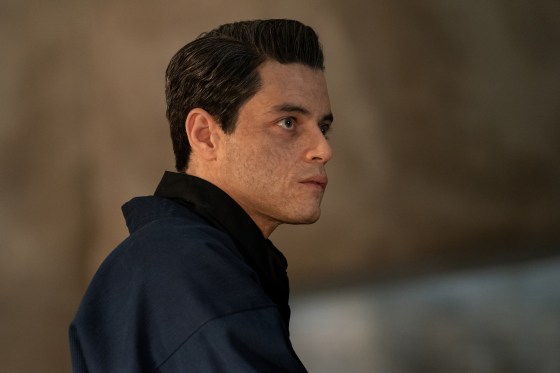
Nicola Dove—© 2020 DANJAQ, LLC AND MGM. ALL RIGHTS RESERVED.Safin (Rami Malek) in ‘No Time to Die’

The path to Bond’s demise starts with the movie’s first major twist, another departure for the famously unattached spy. Halfway through the film, Bond discovers that he has a daughter. It’s a first for any 007.

At the beginning of the movie, Bond finds himself deeply in love with Madeleine Swann (Léa Seydoux), whom he met during the events of Spectre. Swann says that in order for the two of them to have a future together, Bond needs to let go of the memory of Vesper. Bond visits Vesper’s grave in Italy, only for the tomb to explode in an attempted assassination by Spectre goons.

Bond, of course, escapes the explosion relatively unscathed only to be greeted by the aforementioned goons. During a fight scene, one such thug insinuates that Madeleine betrayed him—just like Vesper had. A wounded Bond kills the bad guys and puts Madeleine on a train, planning to never see her again. He then heads to a remote island to live out his retirement in teeny, tiny swim trunks.

Five years later, Bond is dragged back into the spy game and collides with none other than Madeleine, who is now working as a therapist for MI6. And, surprise! She has a daughter. (MI6 apparently did not know about this child, which makes one seriously question the abilities of the Brits to gather intelligence. A dozen megalomaniacs have vendettas against Bond at this point. Maybe they should keep better track of his possible offspring, who would be obvious targets for kidnapping?)

Madeleine claims the child is not Bond’s. It’s a pretty obvious lie. As Bond points out, they share the same intense blue eyes. Madeleine will, of course, later in the movie confess that his suspicions are well-founded. Predictably, the movie’s villain, Safin (Rami Malek) kidnaps Madeleine and the child and takes them to his lair, an island where he harvests a bunch of different poisons because, well, he’s a creepy Bond villain.

Safin is mass-producing a bioweapon, a poison that is programmed to people’s specific DNA. If the targeted person is exposed to that poison, they will die, even though the carrier of the toxin will remain unharmed. He wants to use the poisons to target specific people and throw the world into chaos for vague bad-guy reasons.

With the help of another 00 agent, Nomi (Lashana Lynch), Bond gets Madeleine and their daughter off the island. Bond stays behind to open a bunch of missile silos so that the Brits can blow the place to smithereens, only to encounter Safin on his way out. Safin poisons Bond with a toxin that will specifically kill Madeleine and their daughter if Bond goes anywhere near them, which means Bond can never touch his love or child ever again. Tech genius Q (Ben Whishaw) tells Bond that there’s no way to remove the toxin once it’s been applied. How he can possibly know this—and whether some experimentation over the course of years could lead to a cure—is unclear, but Bond accepts this fate quickly.

Bond shoots Safin dead, and then calls Madeleine to wish her farewell as he watches several missiles approach the island. And then, boom, Bond is gone. Whether you’re a fan of Daniel Craig’s portrayal of Bond or not, it’s a rather poetic ending to the era. The five films that starred him successfully pivoted the franchise from one-off romps filled with fast cars, cool gadgets and, yes, the Bond woman, to a brutal epic of a hitman trying to find his soul.

But Bond’s death was also necessary for this franchise to survive.

Was a permanent end necessary to let Daniel Craig finally bow out?

NO TIME TO DIE
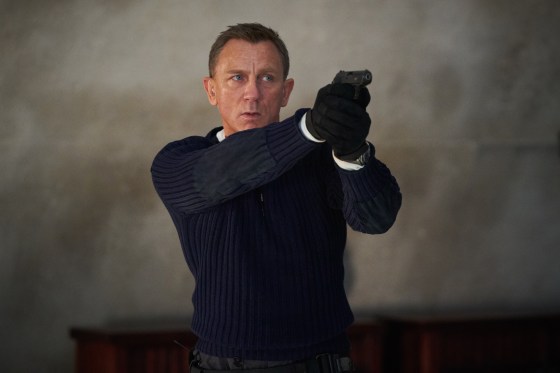
Nicola Dove—© 2020 DANJAQ, LLC AND MGM. ALL RIGHTS RESERVED.Daniel Craig thesays farewell to the storied franchise

It’s no secret that Daniel Craig has wanted out from the Bond franchise for awhile now. He infamously declared in 2015 he’d rather “slash his wrists” than return the character and quipped that if he did come back it would only be for money. He did, of course, end up coming back for one more outing. One can’t help but speculate that he returned to the franchise on the condition that he be offed by the end of the film so a massive paycheck could never tempt him again.

He’s not the first actor to want out of an iconic role. Harrison Ford reportedly begged George Lucas to kill Han Solo before finally getting his wish at the hands of J.J. Abrams, decades later, in The Force Awakens. Leonard Nimoy reportedly wanted to kill off Spock in Wrath of Khan only to later change his mind. Even Sean Connery, the man who made James Bond an icon, wanted 007 dead after playing the character seven times (though he never got his wish). Onscreen deaths can not only offer an actor a reprieve from a role that offers diminishing creative returns, but a heroic and bittersweet demise can also engender sympathy for a character and cement their cinematic legacy.

Craig craved an identity beyond the Bond character. Thankfully, he has found it in other films, particularly as Detective Benoit Blanc in Knives Out, which is getting a whole series of movies on Netflix. Now, unless the Bond Cinematic Universe goes the way of superhero films and begins resurrecting characters using time travel, quantum mechanics and whatever other movie magic the writers can think up, he’ll be able to move on from Bond forever.

Bond’s sacrifice gives him a redemptive arc that modern audiences need

NO TIME TO DIE
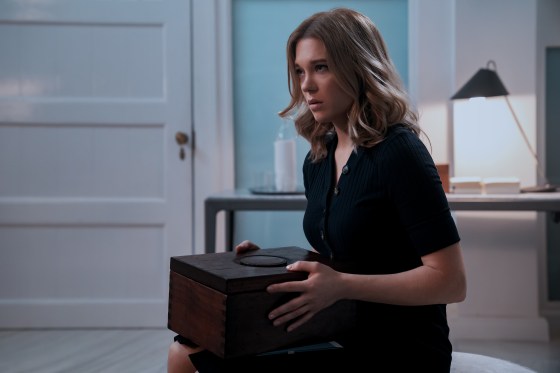
Nicola Dove—© 2020 DANJAQ, LLC AND MGM. ALL RIGHTS RESERVED. Dr. Madeleine Swann (Léa Seydoux) in ‘No Time to Die’

We all know that the character of James Bond is problematic. The character has a history of raping, objectifying and using women. And Bond movies often glamorized that behavior. The character taught generations of men that misogyny was cool. Just as little girls look to figures like Barbie to perceive what they should be, what they should value and how they should interact with men when they grow up, so too do little boys look for cues from famous, enduring figures like Bond.

To its credit, Casino Royale tried to reckon with the question of how, exactly, Bond became such a misogynist. A betrayal by a woman provided part of the answer, though misogyny seemed to be baked into Bond’s very character. Before Craig’s Bond ever meets Vesper, he sleeps with a woman for information and is hardly perturbed when he finds her brutally murdered the next day. By the end of the movie, when he finds out that Vesper both betrayed and saved him, he responds, infamously, “The bitch is dead.”

It’s hard to reconcile that brutal perspective with the fact that Bond remained eminently hip—a familiar vehicle through which tailors and car dealers and watchmakers could hawk their wares to an adoring public. The movie wanted us to acknowledge this man we idolized was a monster, but didn’t want us to stop idolizing him.

How, exactly, that character could survive a post-#MeToo era was unclear. Could the world’s most famous fictional misogynist endure? Would he have to reform?

Given the choice between reckoning with Bond’s past and ignoring it, No Time to Die—the first Bond movie filmed since #MeToo went viral in 2017leans into the latter. Nomi, who bears the title of 007 herself for much of the film, occasionally quips that Bond is a dinosaur. But by the end of the movie, she cedes the 007 title to him as a sign of respect, seemingly offering her approval and erasing any of his past misdeeds.

How does Bond go from questionable womanizer to good guy so quickly? The answer lies squarely at the feet of his daughter. As soon as she enters the picture, the most brutal things Bond does, like dropping a car on a bad guy begging for his life, are not out of coldness but in service of this innocent. The audience automatically extends sympathy to a man just trying to defend his family. He is, to use a phrase that has been wielded (and mocked) widely in recent years, now the forever awakened father of a daughter.

This isn’t a new trick in Hollywood. Dads looking to protect, specifically, their young girls have been in vogue as of late: Just look at Taken, Stillwater, Sweet Girl and, in the closest parallel to the current Bond plot, Avengers: Endgame.

Read more: From Stillwater to Sweet Girl, A New Crop of Movies Explores the Plight of Modern Dads

Hollywood has a knack for redeeming womanizers

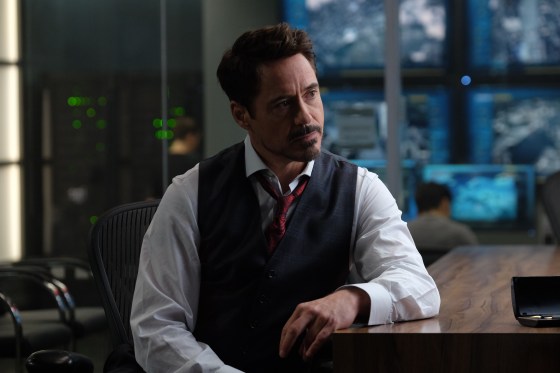
Zade Rosenthal—Marvel StudiosTony Stark/Iron Man (Robert Downey Jr.) in Captain America: Civil War

This redemption arc is a familiar one. Only two years after Casino Royale premiered, Iron Man debuted, launching the Marvel Cinematic Universe (MCU). The movie improbably starred the world’s biggest playboy as a superhero. Like Bond, Robert Downey Jr.’s Tony Stark engaged in some womanizing that has aged particularly poorly, including sleeping with a journalist that Stark’s assistant, Pepper Potts, deems “trash,” and ogling bikini pictures of Scarlett Johansson’s Black Widow, whom Pepper observes is “a very expensive potential sexual harassment suit.” (The fact that Gwyneth Paltrow as Pepper Potts had to utter both of these putdowns of fellow women is particularly gross.)

Read More: Black Widow Began as a Sexist Stereotype. More Than a Decade Later, Scarlett Johansson Is Reclaiming Her Story

But by the time that (spoiler alert for Avengers: Endgame) Tony Stark sacrificed himself at the end of that saga, he was—you guessed it—the father of an adorable little girl, an all-around family man and unassailable hero. Both franchises had years to get with the times, to transform IP created for another era (Bond and Iron Man were conceived in 1953 and 1963, respectively) into the sorts of protagonists we can actually applaud today.

In fact, No Time to Die and Avengers: Endgame bear striking parallels. Bond and Stark are both anti-heroes who do questionable things for the sake of humanity, even if Bond puts a grimmer spin on his actions than the smirking Tony Stark. Each reforms, retires and seemingly finds his happily-ever-afters off the beaten path—Bond gleefully whispers “Je t’aime” to Madeleine as they tumble into bed at an Italian hotel together at the beginning of No Time to Die; Stark, meanwhile, feeds his daughter ice pops in the woods as they tell each other, “I love you 3000.”

A plea to return to the fray arrives from a friend, Felix Lighter in Bond’s case and Steve Rogers in Stark’s. Each agrees, in part because of guilt. (Stark gazes at a picture of the disappeared Peter Parker he failed to save, Bond tells Madeleine his greatest regret is putting her on that train.) After a touching scene with their mini-mes—Stark’s daughter dons the Iron Man helmet, while Bond’s daughter blinks up at him with his bright blue eyes—they sacrifice themselves for the greater good.

With that, the redemption arc that might win over even the most skeptical audience members is complete. And it offers a clean slate to whoever might come next.

Where does the Bond franchise go from here?

NO TIME TO DIE
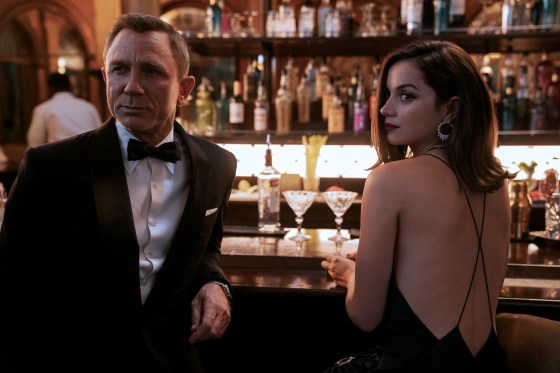
Nicola Dove—© 2020 DANJAQ, LLC AND MGM. ALL RIGHTS RESERVED.James Bond (Daniel Craig) and Paloma (Ana de Armas)

Does Bond’s death (and the fact that it so heavily evokes the sacrifice of a superhero) suggest that we’re about to get the Marvelization of Bond? That might seem antithetical to the franchise, which has always casually recast new actors to play the role without ever commenting on it in the film. Bond exists outside of time and space, never explicitly aging and always evolving to suit the needs of a new era.

The Craig era of Bond movies has strayed from that ethos a bit. This Bond did, indeed, grow old and now has met his demise. Many 007 fans booed Spectre exactly because it got so bogged down in the mythology of the franchise, tracing which old villains came from where and obsessing over the hero’s origin story rather than cool cards and well-cut suits. If Bond has gained gravity, even gained a soul, he’s lost the lightness of those first films. Until now, the Bond films could be watched in a vacuum or as part of a binge, and even the silliest ones satisfied because of just how ridiculous and disposable everything and everyone in them was, including not only the Bond girls but also the hero himself, subbed out every few years. In such a grim offscreen moment, fans would be forgiven for longing for that carefree version of the character.

But is Bond’s misogyny so coded into his DNA that it’s impossible to remake this character? Craig’s Bond bore women ill feelings, and the series reckoned with them only slightly before offering him a saving grace in the form of a daughter. Would another, lighter version simply make light of the fact that this character has existed in the public imagination as an chauvinist for all this time?

It’s hard to imagine it would. It wasn’t 007 slapping girls in the face that made those older Bond movies enjoyable. It was the lightness with which he handled even the most terrifying villain’s plots, meeting them with a quip and a swig of his martini.

The producers have said they won’t begin their hunt for the next Bond until next year. And though the introduction of Nomi suggested Lynch might inherit the role, producers and Craig have shut those rumors down. Craig recently said that he didn’t think Bond should be a woman. “Why should a woman play James Bond when there should be a part just as good as James Bond, but for a woman?”

While that might be the ideal circumstance, that suggestion ignores the fact that nobody (save, perhaps, Christopher Nolan) can seem to get an original idea greenlit in Hollywood these days. Studios are obsessed with IP and old, proven IP, especially in the domain of action and spy thrillers, simply does not exist for women. Searching for a history of female spies, all one can find is Charlie’s Angels, whose gender politics are so fraught to that story of three women at the beck and call of a mysterious man may be impossible to adapt well. The most promising female spy movie may in fact be a spinoff from the Bond franchise, perhaps one set in Cuba and starring Ana de Armas, the breakout star of No Time to Die (and Craig’s co-star in Knives Out).

But certainly, now that Craig has put his Bond to bed, the Broccoli family has an opportunity to signal to the world that they are rethinking this character, dragging him into the modern era if they must. They can reshape him or confront his past. But they cannot outrun his legacy.

New top story from Time: Now India Faces Electricity Crisis as Coal Supplies Dwindle to 3 Days’ Worth


Supplies across the majority of coal-fired power plants in India have dwindled to just days worth of stock.

Federal Power Minister R. K. Singh told the Indian Express newspaper this week that he was bracing for a “trying five to six months.”
[time-brightcove not-tgx=”true”]

“I can’t say I am secure … With less than three days of stock, you can’t be secure,” Singh said.

The shortages have stoked fears of potential black-outs in parts of India, where 70% of power is generated from coal. Experts say the crunch could upset renewed efforts to ramp up manufacturing.

Power cuts and shortages over the years have subsided in big cities, but are fairly common in some smaller towns.

Out of India’s 135 coal plants, 108 were facing critically low stocks, with 28 of them down to just one day’s worth of supply, according to power ministry data released on Wednesday, the most recently available.

On average, coal supplies at power plants had fallen to about four days worth of stock as of the weekend, the ministry said in a statement. That’s a sharp plunge from 13 days in August.

Power consumption in August jumped by nearly 20% from the same month in 2019, before the pandemic struck, the power ministry said.

“Nobody expected economic growth to revive like this and for energy demand to shoot up so quickly,” said Vibhuti Garg, an energy economist at the Institute for Energy Economics and Financial Analysis.

The shortfalls in supply were worsened by flooding of mines and other disruptions from unusually heavy rains, Garg said.

India mostly relies on domestically mined coal. With global coal prices at an all-time high, increasing imports is not an option, experts said.

The government has asked state-run Coal India Ltd. to increase production.

Coal prices in Indonesia, one of India’s suppliers, swelled to nearly $162 per ton this month from $86.68 in April, boosted by surging demand in China, where recent power cuts have forced factories to shut down and left some households in the dark.

“With the current prices, it is difficult for India to rely on external sources for coal as it’s about two or three times more than what we pay domestically right now,” said Swati DSouza, research lead at National Foundation for India.

With monsoon rains receding, coal deliveries have picked up and are likely to rise further, according to the power ministry. An official team is monitoring the situation and following up with Coal India Ltd. and the railways to improve supplies, the ministry said.

But the crisis has highlighted India’s need to develop more renewable energy resources given that demand is likely to keep increasing.

It should serve as a “turning point for India,” where there is ample renewable energy potential to help offset such disruptions, said Sunil Dahiya, an analyst at the Center for Research on Energy and Clean Air.

“The situation shouldn’t be used to push for more coal — that is not the crisis. The solution going forward is to move away from coal and other fossil fuels,” he said.

AP science writer Victoria Milko contributed from Jakarta, Indonesia.

New top story from Time: Journalists Maria Ressa and Dmitry Muratov Win Nobel Peace Prize for Fighting for Freedom


(OSLO) — The 2021 Nobel Peace Prize was awarded Friday to journalists Maria Ressa of the Philippines and Dmitry Muratov of Russia.

They were cited for their fight for freedom of expression.

The winners were announced Friday by Berit Reiss-Andersen, chair of the Norwegian Nobel Committee.

“Free, independent and fact-based journalism serves to protect against abuse of power, lies and war propaganda,” said Reiss-Andersen.

“Without freedom of expression and freedom of the press, it will be difficult to successfully promote fraternity between nations, disarmament and a better world order to succeed in our time.”

Dmitry Muratov
Alexander Zemlianichenko–APIn this Oct. 7, 2021 file photo, Novaya Gazeta editor Dmitry Muratov speaks during an interview with The Associated Press at the Novaya Gazeta newspaper, in Moscow, Russia. The 2021 Nobel Peace Prize was awarded to journalists Maria Ressa and Dmitry Muratov for the fight for freedom of expression in the Philippines and in Russia.

[time-brightcove not-tgx=”true”]

Ressa in 2012 co-founded Rappler, a news website that has focused “critical attention on the (President Rodrigo) Duterte regime’s controversial, murderous anti-drug campaign,” the Nobel committee said.

She and Rappler “have also documented how social media is being used to spread fake news, harass opponents and manipulate public discourse.”

Muratov was one of the founders of the independent Russian newspaper Novaya Gazeta in 1993.

“Novaya Gazeta is the most independent newspaper in Russia today, with a fundamentally critical attitude towards power,” the Nobel committee said.

“The newspaper’s fact-based journalism and professional integrity have made it an important source of information on censurable aspects of Russian society rarely mentioned by other media,” it added.

Kremlin spokesman Dmitry Peskov congratulated Muratov on winning the prize, hailing him as a “talented and brave” person.

“We can congratulate Dmitry Muratov — he has consistently worked in accordance with his ideals, he has adhered to his ideals, he’s talented and brave. It’s a high appraisal and we congratulate him,” Peskov said in a conference call with reporters after the prize was announced.

The prestigious award is accompanied by a gold medal and 10 million Swedish kronor (over $1.14 million). The prize money comes from a bequest left by the prize’s creator, Swedish inventor Alfred Nobel, who died in 1895.

On Monday, the Nobel Committee awarded the prize in physiology or medicine to Americans David Julius and Ardem Patapoutian for their discoveries into how the human body perceives temperature and touch.

The Nobel Prize in physics was awarded Tuesday to three scientists whose work found order in seeming disorder, helping to explain and predict complex forces of nature, including expanding our understanding of climate change.

Benjamin List and David W.C. MacMillan were named as laureates of the Nobel Prize for chemistry Wednesday for finding an easier and environmentally cleaner way to build molecules that can be used to make compounds, including medicines and pesticides.

The Nobel Prize for literature was awarded Thursday to U.K.-based Tanzanian writer Abdulrazak Gurnah, who was recognized for his “uncompromising and compassionate penetration of the effects of colonialism and the fate of the refugee.”

Still to come Monday is the prize for outstanding work in the field economics.

Tuesday, October 5, 2021

New top story from Time: Here Are the Favorites To Win the 2021 Nobel Peace Prize


The Nobel Committee is set to announce the winner of the Nobel Peace Prize on Friday in Oslo, Norway.

Regarded as one of the world’s most prestigious accolades, the Nobel Peace Prize is one of six awards established by Alfred Nobel in 1895 to acknowledge work of “the greatest benefit to humankind.” Last year’s winner of the the award and $1 million cash prize was the World Food Programme, the world’s largest humanitarian organization, for its efforts to combat global hunger, particularly in areas of conflict.
[time-brightcove not-tgx=”true”]

In a turbulent year marked by the ongoing COVID-19 pandemic, political turmoil and warnings of environmental crisis, there are 329 candidates for the Peace Prize — the third highest number ever. Every year, the Nobel committee asks academics, scientists, former winners and politicians from a range of countries to submit nominees.

The list will be kept secret for another 50 years, but a survey by Reuters of Norwegian lawmakers found that climate activist Greta Thunberg and political dissidents Svetlana Tikhanovskaya and Alexei Navalny are in the running.

The Committee is famously unpredictable in its choice of laureate, and rarely follows popular trends. Nonetheless, here’s a list of oddsmakers’ favorites to win the prestigious accolade:

The World Health Organization

Almost two years after the first known outbreak of COVID-19 was recorded in Wuhan, China, the pandemic continues to shape our daily lives and dominate political discourse. While resurgent waves and deadlier variants have challenged governments around the world, the World Health Organization has remained a leading figure in co-ordinating the international response.

The WHO was tipped as a potential laureate in 2020, only to lose out to another UN agency, the World Food Programme. Since then, the organization has overseen a controversial investigation into the origins of the COVID-19 pandemic in China and navigated the multinational temporary suspension of the AstraZeneca vaccine due to blood clot fears. The WHO also overcame a temporary suspension of funding from the U.S. by President Donald Trump which was reinstated by President Joe Biden in January.

One of the WHO’s biggest priorities this year has been on equal and fair access to COVID-19 vaccines in all countries. Since it began distributing vaccines in Feb. 2021, the WHO-backed COVAX program has delivered over 311 million COVID-19 vaccines to 143 participating countries.

The scheme has not been without controversy, however, as COVAX failed to hit its initial target of 100 million vaccines delivered in March 2021—a continuing shortage of vaccines for the scheme has been blamed on “vaccine nationalism” in developed countries.

Alexei Navalny

TOPSHOT-RUSSIA-POLITICS-OPPOSITION-NAVALNY
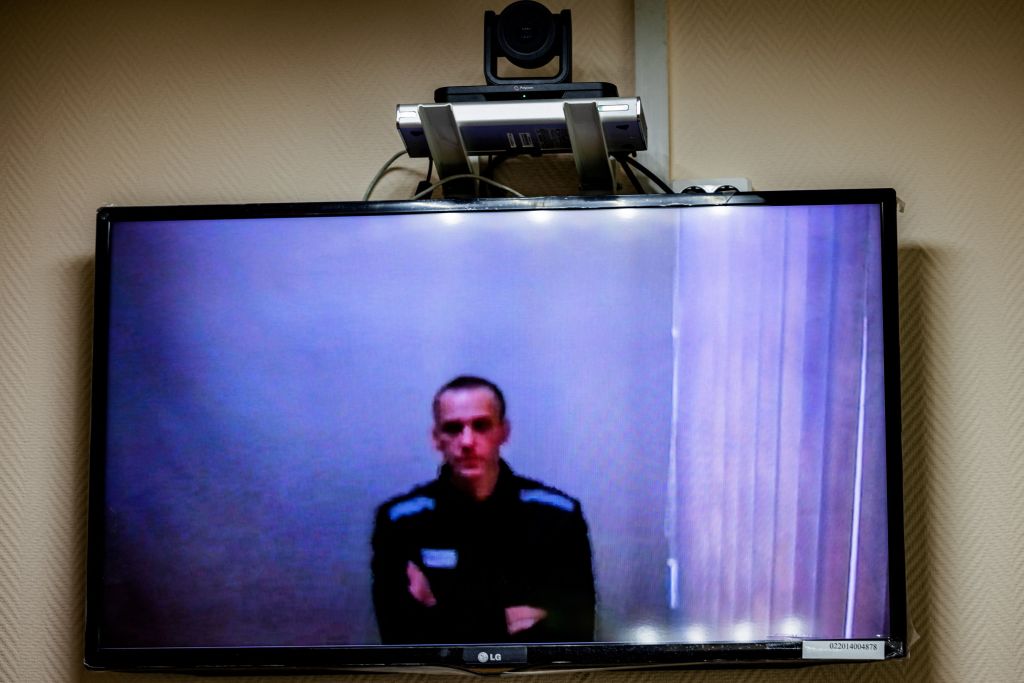
Dimitar Dilkoff—AFP/Getty ImagesJailed Kremlin critic Alexei Navalny appears on screen via a video link from prison during a court hearing, at a court in the town of Petushki some 120 kilometres outside Moscow, on May 26, 2021.

One of Vladimir Putin’s most influential opponents, activist and opposition leader Alexei Navalny was nominated by academics for his work fighting state corruption in Russia. While a well-known figure for the past decade as a would-be challenger to Putin, Navalny this year became a prisoner of conscience.

In Aug. 2020, Navalny was hospitalized after being poisoned with the nerve agent Novichok, allegedly by members of the Russian secret service, the FSB. After recovering in a German hospital, he voluntarily returned to Russia in Jan. 2021 only to be immediately detained on charges of violating parole for prior convictions widely believed to be politically motivated. He was sent to a penal colony where he says he is subjected to “psychological violence,” including being forced to watch state TV eight hours a day. The events provoked mass protests in Russia.

Despite the bleak circumstances, Navalny has remained a vocal critic of Putin from prison, penning articles for the Guardian and being interviewed by the New York Times. He called on Western governments to take a tougher stance on corrupt foreign powers, but criticized U.S. and European sanctions for harming Russian citizens.

In Aug. 2021 he was issued with fresh charges which could mean he will remain in prison until after the next presidential elections in 2024. He has been recognized by Amnesty International as a “Prisoner of Conscience” and was named one of TIME’s 100 Most Influential People of 2021.

Greta Thunberg

Fridays For Future Holds Climate Strike March In Milan
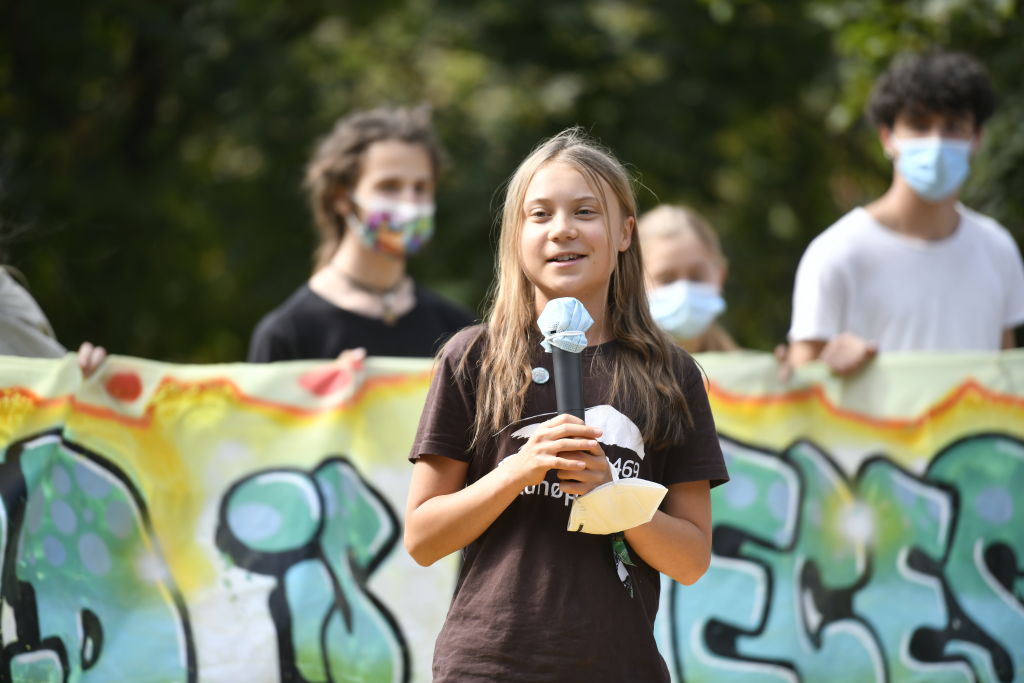
Stefano Guidi—Getty ImagesGreta Thunberg speaks during the climate strike march on Oct. 1, 2021 in Milan, Italy.

Swedish teenage climate activist Greta Thunberg, TIME’s 2019 Person of the Year, has been a favorite to win the Nobel Peace Prize every year since 2019. Prize watchers say this could be her year; former laureates Malala Yousafzai and Congolese doctor Dennis Mukwege were likewise tipped for victory several years before they actually won.

Since the wave of international school climate protests started by Thunberg in 2018, she has continued to call on global powers to commit to tackling the climate crisis. At the Youth4Climate summit last month, Thunberg condemned political leaders’ “empty promises” and “lack of action” to limit global temperature rises to 35F (1.5C). In May 2021, she turned her attention to the food production industry and its link to virus outbreaks such as COVID-19, arguing that a shift to plant-based diets would reduce emissions and the risk of future pandemics.

The latest Intergovernmental Report on Climate Change published in August issued a stark warning that catastrophic environmental changes caused by humanity are now inevitable and irreversible. In this context, awarding Thunberg the Peace Prize would send a strong message to attendees of the upcoming United Nations Climate Change Conference (COP26) in November that climate change is the biggest threat facing humanity today.

Svetlana Tikhanovskaya

Svetlana Tikhanovskaya Visits Downing Street
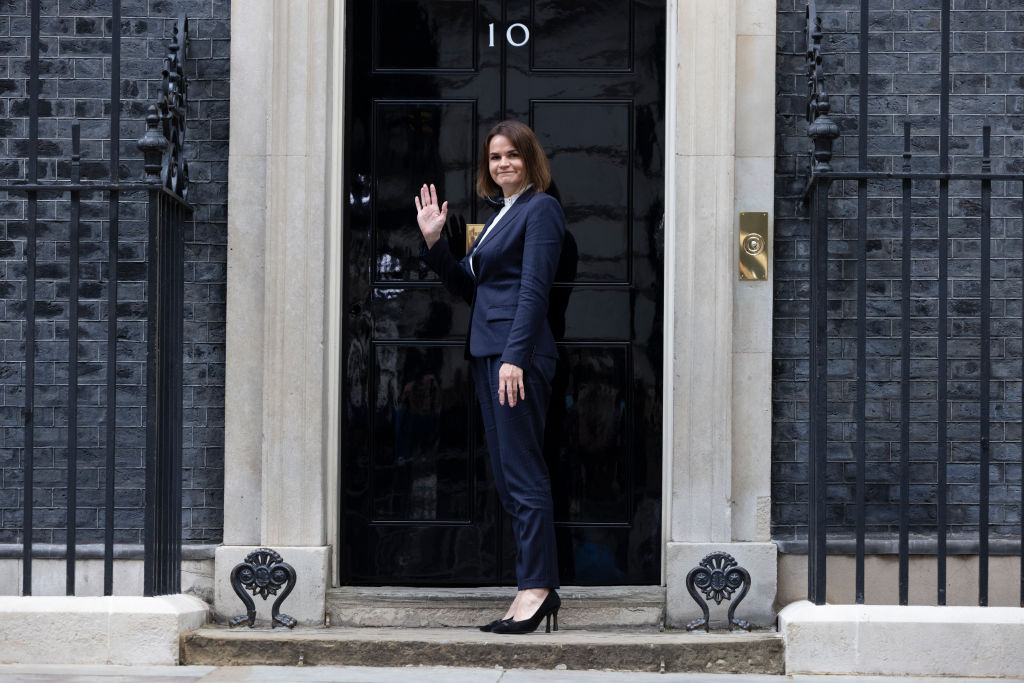
Dan Kitwood—Getty ImagesSvetlana Tikhanovskaya arrives at Downing Street for a meeting with British Prime Minister Boris Johnson on Aug. 3, 2021 in London, England.

Belarusian human rights activists and politician Svetland Tikhanovskaya is more of an outlier in oddsmakers’ books—but so are most Nobel Peace Prize laureates. When President Alexander Lukashenko, dubbed Europe’s last dictator,ordered the arrest of opposition candidate Sergei Tikhanovskaya, Svetlana’s husband, in May 2020, she decided to run as his replacement in the August Presidential elections. She went from a full-time mother to leading a mass movement.

But Lukashenko claimed his own victory despite allegations of electoral fraud. Amid mass protests which saw many activists injured or imprisoned, Tikhanovskaya escaped the country to Lithuania with her two young children. From there, she now heads up the Coordination Council, a government in exile fighting to end Lukashenko’s 26-year rule, and campaigns for the release of her husband. She was named in this year’s TIME’s 100 Next list.

President Joe Biden

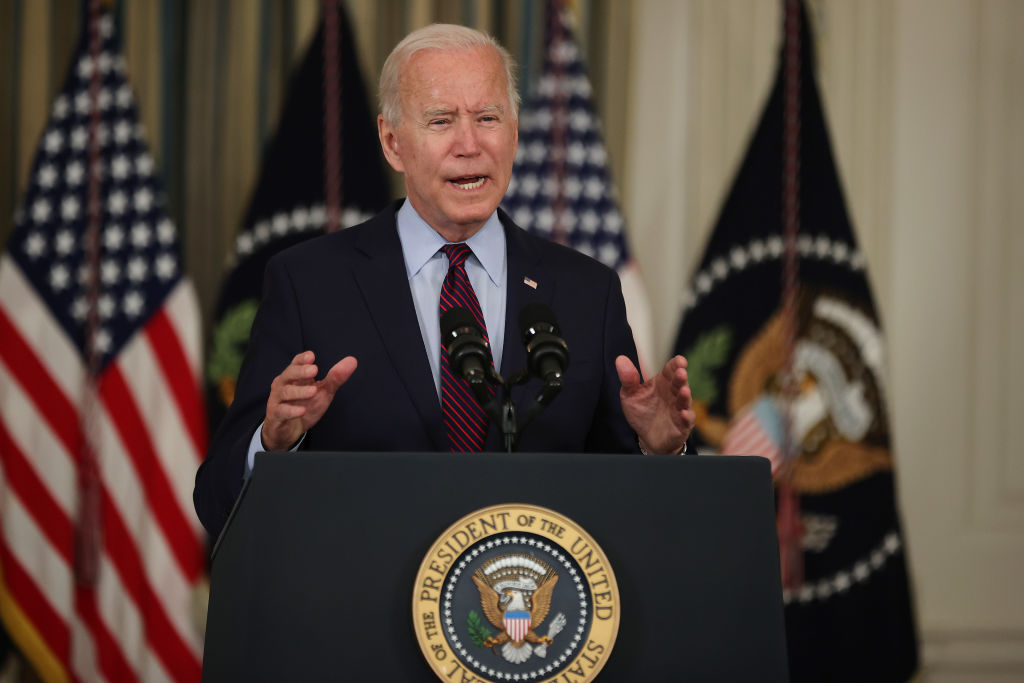
President Biden Discusses Need To Raise The Debt Ceiling
Chip Somodevilla—Getty ImagesPresident Joe Biden delivers remarks about the need for Congress to raise the debt limit in the State Dining Room at the White House on Oct. 4, 2021 in Washington, DC.

When U.S. President Joe Biden was inaugurated in Jan. 2021, he inherited a global pandemic and a divided country from his predecessor. In his first few days in office, he signed dozens of executive orders, including to rejoin the Paris Climate Agreement which President Donald Trump had withdrawn from in 2020, to halt the construction of the U.S.-Mexico border wall, and to reinstate funding to the WHO.

It is not uncommon for Presidents to win the Nobel Peace Prize. In 2009, President Barack Obama was honored in his first year of office. In his 2020 memoir, A Promised Land, Obama recalls his baffled reaction to winning the prize so early in his presidency—”For what?” he asked.

The biggest mark against Biden, however, is the calamitous withdrawal of the final U.S. troops from Afghanistan in August. Military bases were abandoned overnight and the majority of U.S.-allied Afghan interpreters working who applied for visas were left behind, by which point the Taliban had stormed to power. Biden strongly defended his decision not to delay or slow down the withdrawal, despite international concern.

Also in the running: Jacinda Ardern, Reporters Without Borders and more

Among other potential winners that gambling websites give longer odds to are Jacinda Ardern, for her handling of the COVID-19 pandemic in New Zealand (which is now under scrutiny amid a surge of the Delta variant leading the country to abandon its zero-covid target); press-freedom watchdogs Reporters Without Borders and U.S.-based Committee to Protect Journalists; global movement Black Lives Matter for protesting systemic racism; and global organization UNHRC, the U.N.’s agency for the protection of human rights.