Monday, September 28, 2020

New top story from Time: 3 Killed in Northern California as Wildfires Force Thousands to Evacuate


(SAN FRANCISCO) — Northern California’s wine country was on fire again Monday as strong winds fanned flames in the already scorched region, destroying homes and prompting orders for nearly 70,000 people to evacuated. Meanwhile, three people died in a separate fire further north in the state.

In Sonoma County, residents of the Oakmont Gardens senior living facility in Santa Rosa boarded brightly lit city buses in the darkness overnight, some wearing bathrobes and using walkers. They wore masks to protect against the coronavirus as orange flames marked the dark sky.

The fire threat forced Adventist Health St. Helena hospital to suspend care and transfer all patients elsewhere.

The fires that began Sunday in the famed Napa-Sonoma wine country about 45 miles (72 kilometers) north of San Francisco came as the region nears the third anniversary of deadly wildfires that erupted in 2017, including one that killed 22 people. Just a month ago, many of those same residents were evacuated from the path of a lightning-sparked fire that became the fourth-largest in state history.

“Our firefighters have not had much of a break, and these residents have not had much of a break,” said Daniel Berlant, assistant deputy director with the California Department of Forestry and Fire Protection, known as Cal Fire.

Sonoma County Supervisor Susan Gorin evacuated her property in the Oakmont community of Santa Rosa at about 1 a.m. She is rebuilding a home damaged in the 2017 fires.

Gorin said she saw three neighboring houses in flames as she fled early Monday.

“We’re experienced with that,” she said of the fires. “Once you lose a house and represent thousands of folks who’ve lost homes, you become pretty fatalistic that this is a new way of life and, depressingly, a normal way of life, the megafires that are spreading throughout the West.”

More than 68,000 people in Sonoma and Napa counties have been evacuated in the latest inferno, one of nearly 30 fire clusters burning across the state, said Cal Fire Division Chief Ben Nichols. Many more residents have been warned that they might have to flee, even though winds eased significantly Monday afternoon, giving firefighters an opportunity to make some progress, he said.

“The smoky skies that we’re under are a sign that there’s not a lot of air movement out there moving the smoke around,” Nichols said at an evening briefing. “Not good for air quality, and folks outside exercising, but great for us to work on containing this fire and working on putting it out.”

The Glass Fire broke out before 4 a.m. Sunday and merged with two other fires to scorch more than 56 square miles (145 square kilometers) as of Monday. There was no containment. Officials did not have an estimate of the number of homes destroyed or burned, but the blaze engulfed the Chateau Boswell Winery in St. Helena and at least one five-star resort.

Logan Hertel of Santa Rosa used a garden hose to fight flames at a neighbor’s house in the Skyhawk neighborhood until firefighters could relieve him.

“Seems like they got enough on their hands already. So I wanted to step in and put out the fire,” Hertel said.

Dominic Wiggens, who lives in the same neighborhood, evacuated but returned later Monday. His home was still standing, but many others were gone. “It’s so sad,” he said.

Pacific Gas & Electric was inspecting its equipment as it sought to restore power to more than 100,000 customers who had it turned off in advance of gusty winds and in areas with active fire zones. The utility’s equipment has caused previous disasters, including the 2018 Camp Fire that killed 85 people and devastated the town of Paradise in the Sierra Nevada foothills.

More than 1,200 people were also evacuated in Shasta County for the Zogg Fire, spread over 23 square miles (59 square kilometers) by Monday.

Shasta County Sheriff Eric Magrini said three people died as a result of the fire, though he gave no details.

“It’s with a sad heart that I come before you today,” he said, urging residents to heed advice to leave. “When you get that order, evacuate immediately. Do not wait.”

Residences are widely scattered in the forested area in the far northern part of the state. The region was torched just two years ago by the deadly Carr Fire — infamously remembered for producing a huge tornado-like fire whirl.

The causes of the new fires were under investigation.

Mark Ghilarducci, director of the Governor’s Office of Emergency Services, said 2020 has been challenging.

“The silver lining to it is that people who live in California become more prepared, they’re more aware, they know these events take place and we’re seeing a citizenry that does get it and is working hard to be prepared,” he said.

Numerous studies in recent years have linked bigger wildfires in America to climate change from the burning of coal, oil and gas. Scientists say climate change has made California much drier, meaning trees and other plants are more flammable.

The latest fires erupted as a giant ridge of high pressure settled over the West, producing powerful gusts blowing from the interior toward the coast while slashing humidity levels and raising temperatures.

So far in this year’s historic fire season, more than 8,100 California wildfires have now killed 29 people, scorched 5,780 square miles (14,970 square kilometers), and destroyed more than 7,000 buildings.

Most of the losses occurred after a frenzy of dry lightning strikes in mid-August ignited a massive outbreak of fires.

Fire worries were developing across Southern California, although it was unclear how strong the predicted Santa Ana winds would become. Heat and extreme dryness were also expected to create problems.

Conditions were also hot, dry and windy in parts of Arizona, where the Sears Fire in Tonto National Forest north of Phoenix has grown to more than 14 square miles (36 square kilometers) since it erupted Friday. Authorities reported zero containment.

___

Associated Press reporters Christopher Weber and John Antczak in Los Angeles, Juliet Williams in San Francisco and Haven Daley in Santa Rosa, California contributed to this report.

New top story from Time: What to Watch For In Donald Trump and Joe Biden’s First Presidential Debate


Four years ago, Donald Trump prepared to debate his general-election opponent for the first time. Down in the polls to an experienced, traditional pol, he had been reduced to spreading weird rumors and casting doubt on the legitimacy of the vote, even as questions swirled about his personal finances.

Now Trump is the incumbent president, and the conditions could not be more different as he prepares for his first debate with Democratic nominee Joe Biden on Tuesday: a nation wracked by disease, disorder and disasters; an election neither candidate is treating like a foregone conclusion. And yet the similarities to 2016 are striking, from new questions about Trump’s taxes to another open Supreme Court seat. The main similarity, of course, is Trump—a singular political figure who has intensely polarized the nation.

The debate, scheduled to begin at 9 p.m. Eastern at Case Western Reserve University in Cleveland, is especially momentous because voters have had few opportunities to see the candidates up close. Both Trump and Biden have curtailed their travel and in-person campaigning due to the COVID-19 pandemic, though Trump has resumed holding versions of his signature rallies in recent weeks.

Moderator Chris Wallace of Fox News plans to focus the 90-minute discussion on the pandemic, the economy, the court, the candidates’ records, election integrity, and “race and violence in our cities.” Other news—such as a New York Times report that Trump has paid a negligible amount of income taxes over the past decade—could also be on the table.

Trump has not debated since his face-offs with Hillary Clinton four years ago. At the time, his refusal to release his tax returns was much in the news. When Clinton suggested he might be hiding a failure to pay income tax, Trump responded, “That makes me smart.” He also repeatedly refused to pledge to accept the results of the 2016 election if he lost. Meanwhile, Trump and his campaign stoked rumors that Clinton’s “stamina” had been damaged by unknown health conditions.

Though pundits and polls repeatedly judged Clinton the winner, those debates are now principally remembered for Trump’s jarring diversions—at various times, he lurked behind Clinton as she spoke; brought four alleged victims of sexual misconduct by her husband as his guests; and promised to jail her if elected (a pledge he notably abandoned).

Make sense of what matters in Washington. Sign up for the daily D.C. Brief newsletter.

Trump may be a rusty debater, but his relentless presence on Twitter and television over the past four years has accustomed and perhaps inured the American public to his unwavering style: the lilting recitations, fact-challenged asides and derogatory nicknames. After four unrelenting years, Trump will find it difficult to change anyone’s preconceived opinion of him.

Trump has continually portrayed Biden as “dumb,” incompetent and senile, devoid of energy and hiding from voters. Trump’s advisers privately worry he’s set expectations too low—that Biden’s ability to string sentences together will now strike people as impressive. Trump allies have falsely accused Biden of relying on teleprompters, and in recent days Trump himself has trollishly demanded the candidates take a drug test before the debate—another tactic recycled from his tussle against Clinton four years ago.

Political experts say Trump thrives on breaking decorum and creating a memorable spectacle, daring his opponent to object to his out-of-bounds tactics. “Can Biden hold it together against a no-holds-barred wrestler who’s willing to throw sand in people’s faces, gouge eyeballs, exaggerate facts and say things without evidence?” says Will Ritter, a Virginia-based GOP consultant unaffiliated with the Trump campaign. “Do you try to correct him like Hillary did, or do you try to throw your own sand? If you spend the whole time going, ‘No, no, he can’t say that, that’s not true,’ he’s still winning.”

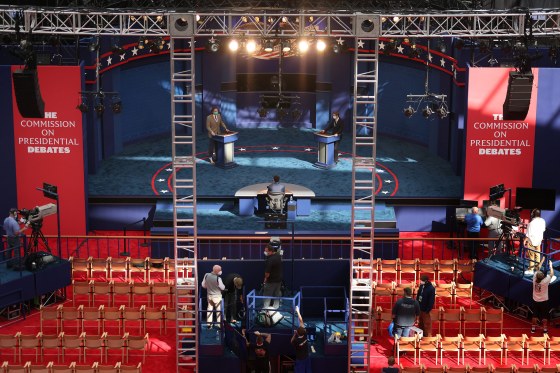
Cleveland Prepares For First Presidential Debate
Win McNamee—Getty ImagesStudents stand-ins for U.S. President Donald Trump and Democratic presidential nominee Joe Biden respectively, participate in a rehearsal for the first presidential debate at Case Western Reserve University in Cleveland, September 28, 2020.

Biden served as vice president for eight years and has been a fixture of national politics for debates, yet is still a less familiar figure to the public, to the point that some Democratic campaigners worry he remains ill-defined. Trump and his allies have signaled they plan to deploy a version of the anti-Clinton playbook, seeking to turn the established politician’s experience into a negative by casting him as part of the failed policies of the past.

In vice presidential debates in 2008 and 2012, Biden cut a fast-talking, sometimes wise-cracking figure, mingling folksy turns of phrase with senatorial disquisitions on the finer points of policy. Ritter, who helped prepare then-GOP vice presidential nominee Paul Ryan to debate Biden in 2012, recalls, “Joe does the ‘aw, shucks, man,’ kind of thing really well, which allows him to roll off the ropes pretty easily. Hillary didn’t have that personality gear.”

Biden has aged since then, and his recent debates against Democratic counterparts were inconsistent. His answers were often meandering or clumsily worded, and he sometimes got lost in obscure reminiscence. Still, his opponents’ attacks rarely seemed to register and frequently backfired; his essential humanity, former opponents say, tended to shine through. “He has this thing where he’ll just flash this big, high-wattage smile instead of getting nasty or defensive, and it serves him well,” says Lis Smith, a Democratic strategist who masterminded Pete Buttigieg’s primary campaign and is unaffiliated with the Biden camp. “He’s a sympathetic figure—there’s just not much value in punching Uncle Joe in the face.”

Democrats are haunted by the ghosts of 2016, when many believe Clinton put too much emphasis on attacking Trump and not enough on defining her own vision or making the case that she represented a change from the status quo. That remains a danger for Biden, whose supporters, polls have shown, are motivated primarily by passionate dislike for Trump.

But Trump, Democrats argue, will have a harder time playing the outsider now that he is the incumbent. “Trump thrives at the lowest level, in the sewer, and he’s going to try everything he can to get Joe Biden down there with him,” Smith says. “But now that we’ve seen what four years of Trump is like, it’s harder to pull the wool over the eyes of voters like he did last time.”

Though the debate promises to be exciting, political observers express doubt that it will have much effect on the outcome of a campaign whose fundamentals have been remarkably stable. Biden leads nationally by an average of seven percentage points—a lead that has neither expanded nor contracted substantially since the onset of COVID-19 or the other seismic events of this dismal year. His leads in most swing states have been similarly steady.

“If a global pandemic and recession couldn’t fundamentally change the numbers in this race, it’s hard to believe 90 minutes of televised debate will,” Smith says.

Ritter, the GOP consultant, echoed that analysis. In the populations his firm contacts for down-ballot campaigns, “we’re not seeing a lot of swing voters,” he says. “People might be tuning into the debate to see if Joe Biden will melt or Donald Trump will do something so beyond the pale it takes your breath away. But I don’t think anyone is going in with an open mind, just curious to see what these two candidates for higher office have to say.”

A judge blocked an early end to the census. The administration moved it back — by only five days.


By BY MICHAEL WINES from NYT U.S. https://ift.tt/3cIFeA6
via IFTTT

Talks on virus relief package resume in Washington.


By BY EMILY COCHRANE from NYT World https://ift.tt/3jc6NUT
via IFTTT

Tax Records Reveal How Fame Gave Trump a $427 Million Lifeline


By BY MIKE MCINTIRE from NYT U.S. https://ift.tt/30gBIId
via IFTTT

Biden maintains lead heading into debate.


By Unknown Author from NYT The Upshot https://ift.tt/3ikoe4p
via IFTTT

For Trump and Biden, the first debate arrives with high stakes, and new drama.


By BY ADAM NAGOURNEY, SHANE GOLDMACHER AND KATIE GLUECK from NYT U.S. https://ift.tt/3icqKJM
via IFTTT